DentOne Oral Rehabilitation Centre
Authors’ Comment
Calm identity and tactile design for a dental clinic
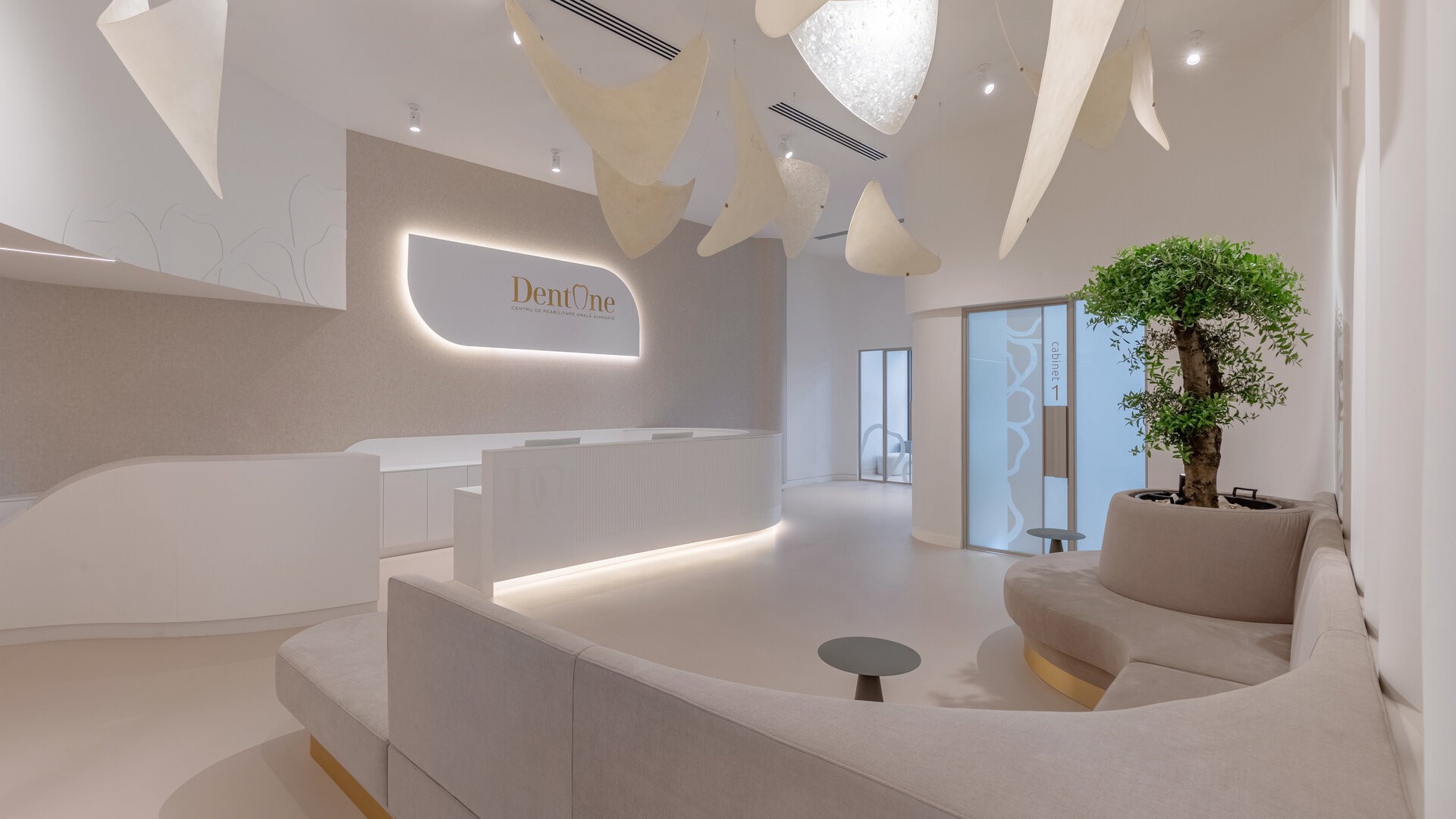
An interior design for DentOne Oral Rehabilitation Centre inside ONE tower building, at its ground floor, on Barbu Vacarescu Boulevard in Bucharest, carried out by studio3plus team, which has a recognized experience in this type of interventions, allowed the development of a fluid concept, imagined as an organic whole through the interior surfaces folding. Unique details, integrated furniture and well-dosed effects of direct and indirect artificial light, contribute decisively to the perception of a calm atmosphere, with dynamic and tactile accents, accentuated also by the suspended sculpture in the reception hall, created by the artist Ileana Oancea.
Rethinking the dental services program
DentOne Oral Rehabilitation Centre, located on the ground floor of ONE Verdi tower „A” building, next to Verdi Park, on Barbu Vacarescu Boulevard in Bucharest, represents the advanced level of a functional program that has transformed spectacularly in the last decade due to the evolution of dental technology and the increase of quality in the medical act itself. This clinic specialized in implantology, bone regeneration and dental aesthetics offers primarily a relationship based on empathy and care for patients, so that the concern for the medical act itself is doubled by the attention to creating an appropriate atmosphere in the spaces dedicated to dental treatments. Investments in state-of-the-art technologies have expanded the old functional concept of dental office; new types of treatments and equipment have been added to support them, consequently diversifying the spatial relationships within the standardized program dedicated to dental medicine. The essential concern for the architectural experience quality in such a centre is proven in this case by the investment allocated to interior design and the trust placed in the studio3plus design team.
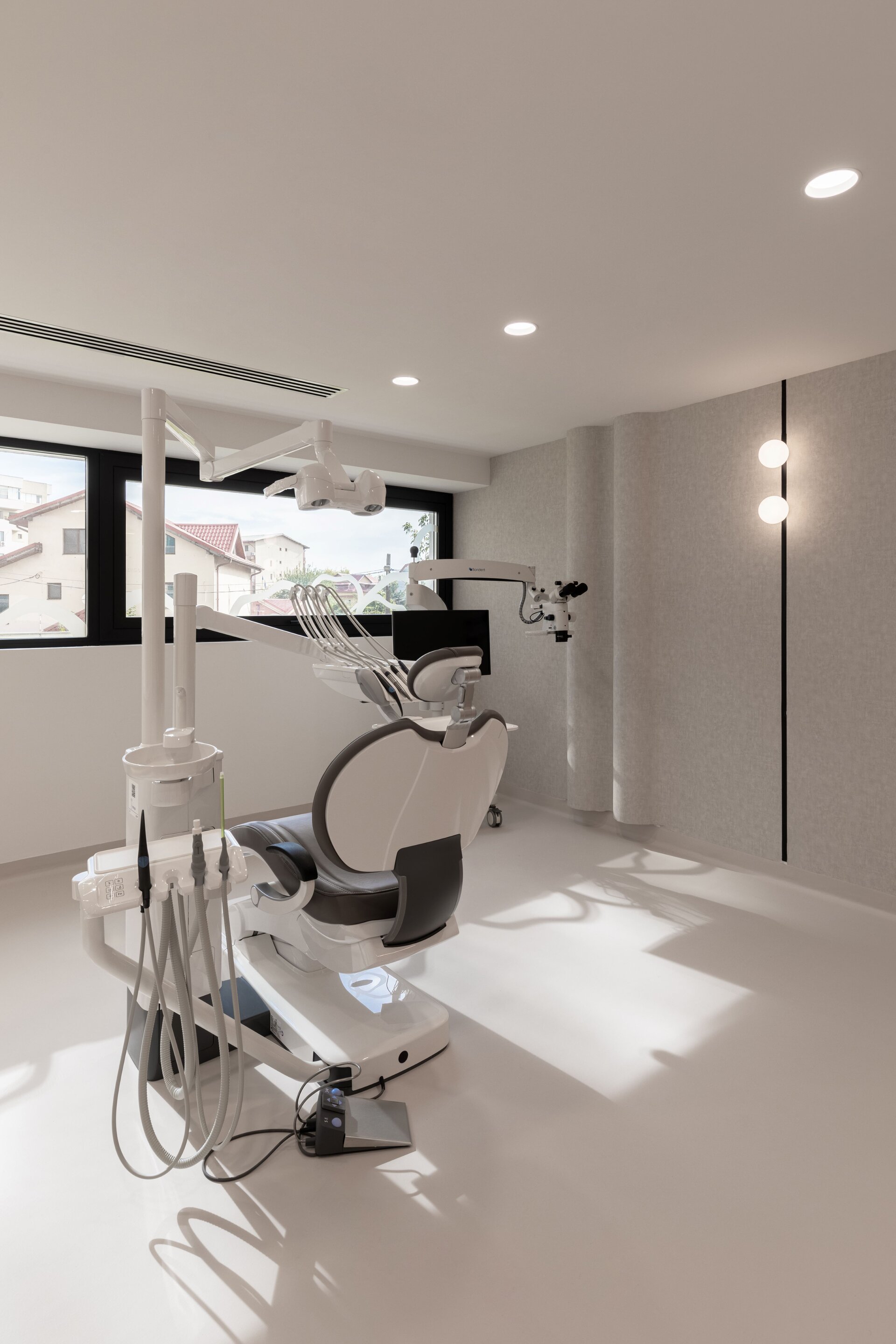
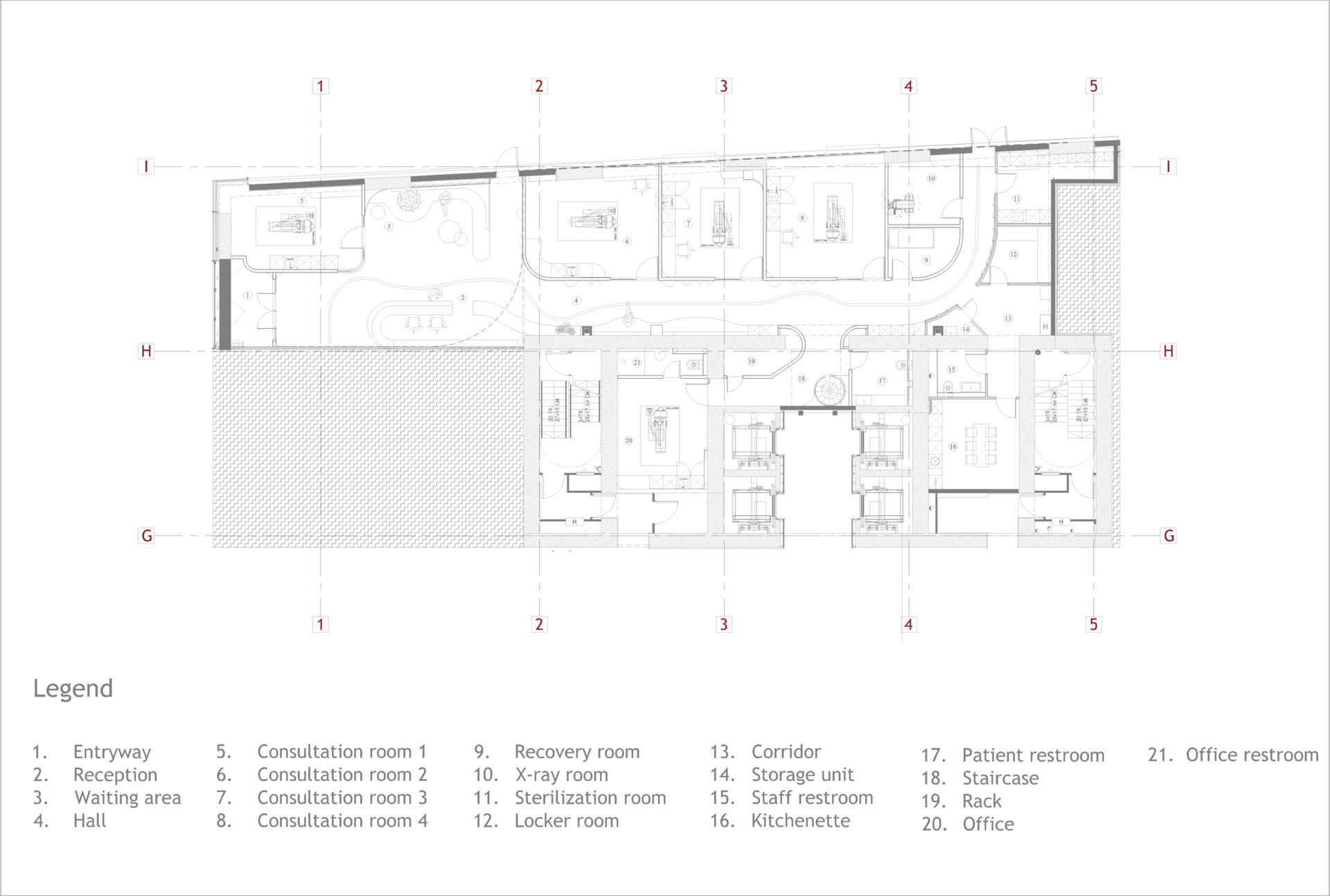
The most important aspect of this functional program is the public reception space for patients, which ensures the connection and orientation to the dentist’s offices, representative of both the professional values of the medical team and the well-being transmitted to those who are about to undergo dental treatments. The 135 sqm area allocated to the reception and waiting halls required the most important design effort to convey the DentOne Centre representativeness and distinct character in the landscape of similar services. Four dentist’s offices with areas ranging between 21 and 25 sqm, to which is added a radiology room (9 sqm), make up the medical experience core, supported by ultra-modern equipment, necessary for both the comfort of specialists and the safety of patients. This functional program extends through the rooms allocated to equipment sterilization (10.7 sqm), patient reserve (7 sqm), staff locker (6.3 sqm), kitchenette (15 sqm), office (16.8 sqm), separate sanitary groups for patients and staff (16.5 sqm), storage and the staircase space to the archive from the upper withdrawn floor allowed by the high ground floor (14.85 sqm). An important part of the project concerns the requirements related to fire protection and evacuation in the context of a ground floor intervention area in the tallest residential building complex in Bucharest, with 20 floors for 300 apartments, which also contains other commercial spaces.
Vibration of surfaces and calm experience of the interior
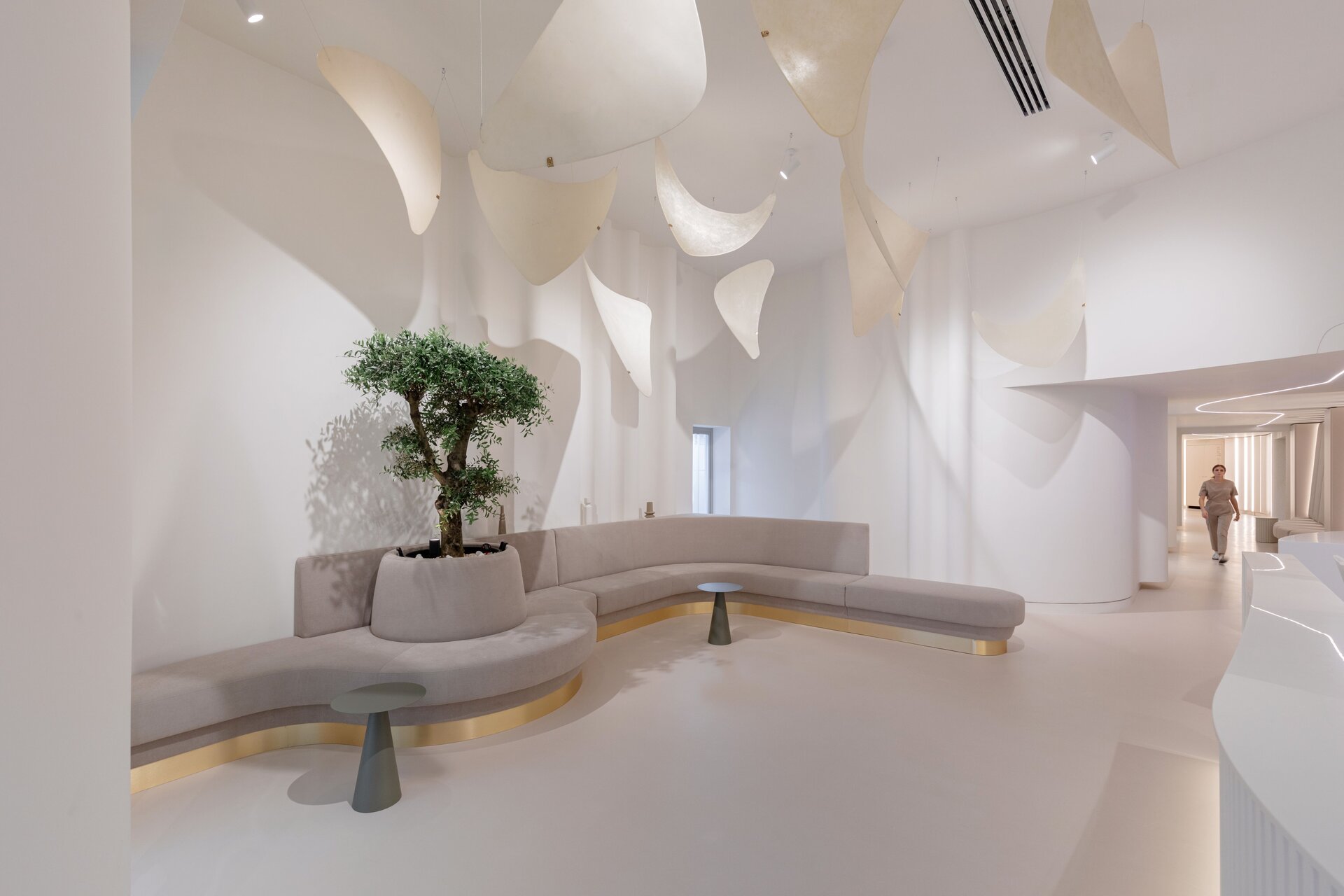
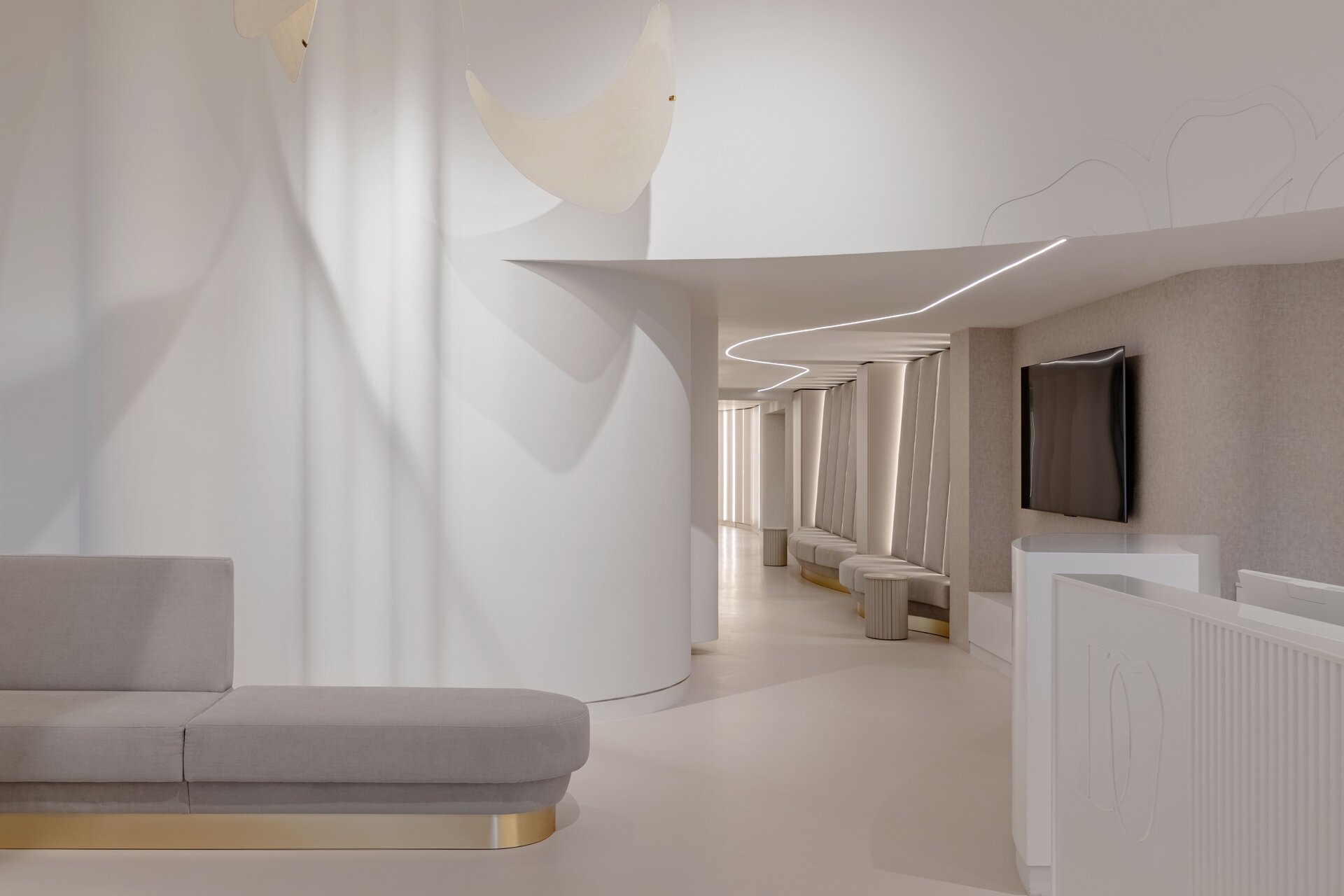
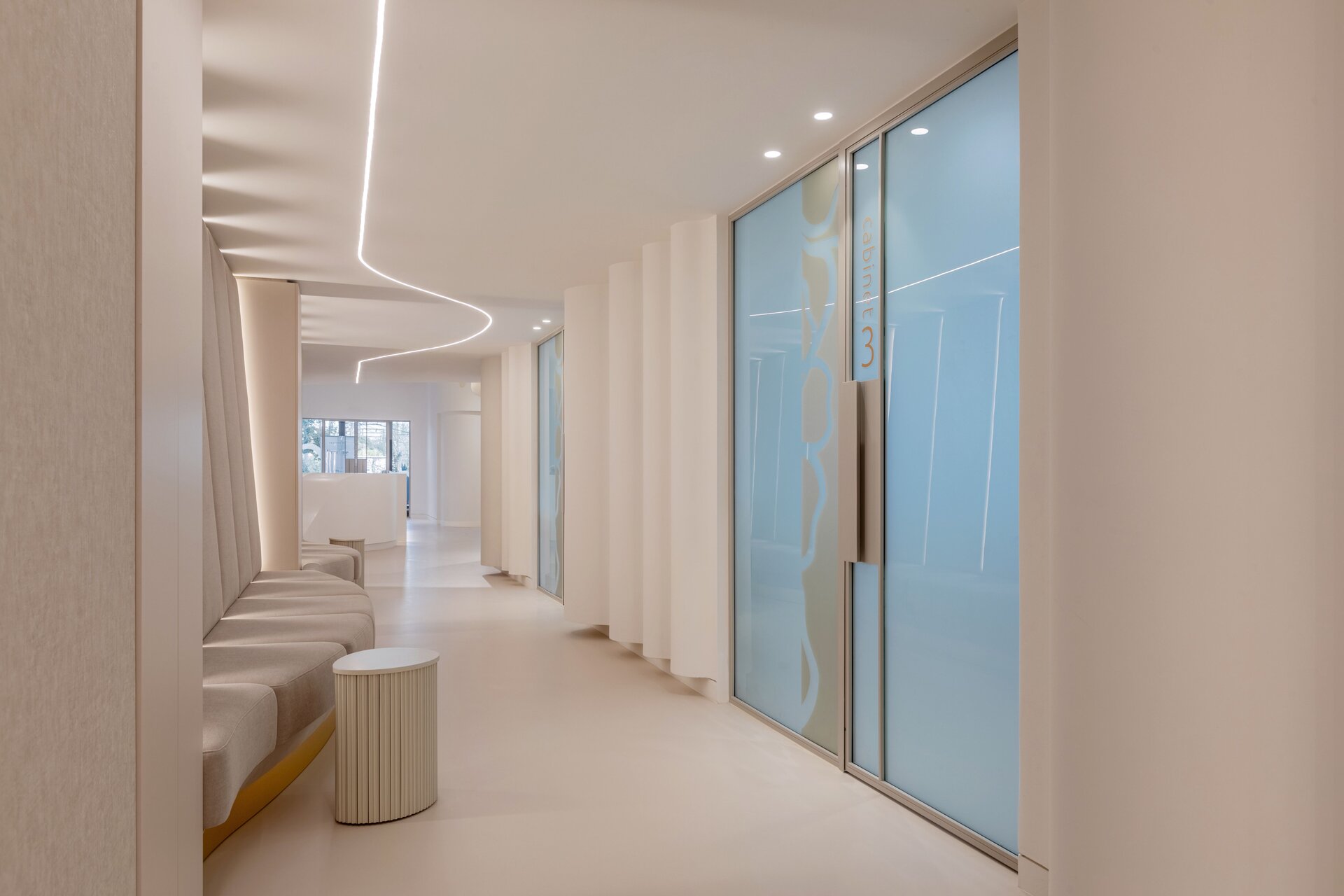
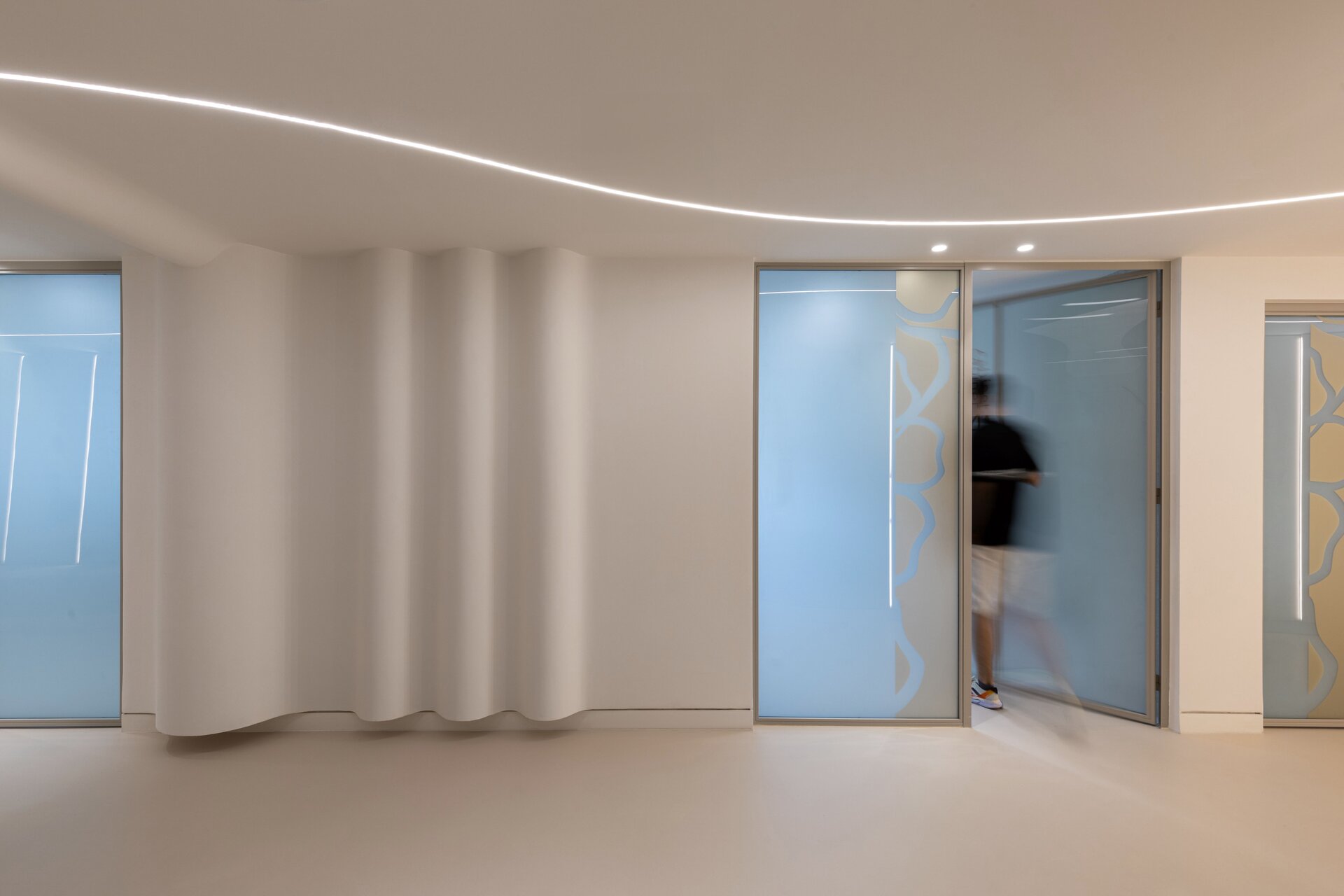
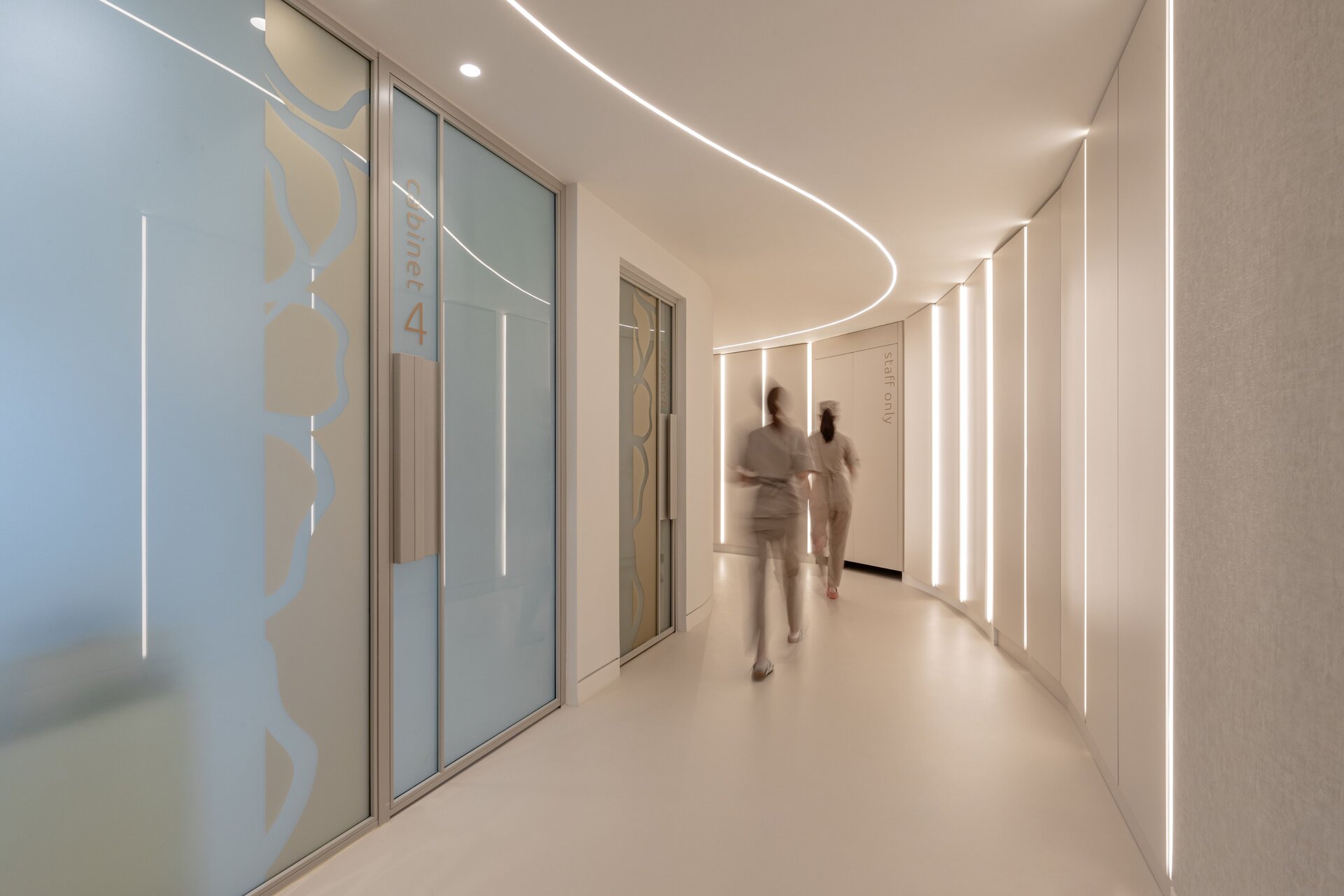
The perimeter available for interior design intervention has an irregular outline, the long side from the facade, with windows, being allocated to the offices, and the one without natural light, in the central area of the ground floor, to the service spaces. Widening and narrowing accordingly, the reception lobby, leading patients to the offices, offers welcoming waiting areas through the integrated furniture. The identity of this coagulating space is conferred by the way in which the vertical surfaces, based on standard plasterboard cladding, undulate spectacularly, becoming spatial folds with varying amplitudes through the application of customized polystyrene profiles, cut with CNC technology, over the regular cladding. Curved connections are also found on the partition walls of the offices from the lobby, “tame” the transitions from the wide reception areas to the narrower waiting ones. A LED light strip at the bottom of the reception desk and the curved one on the ceiling in the hall in front of the offices guide patients into the interior space, towards the offices access doors, and ensure continuity of perception along the undulating and visually vibrating planes. Brass skirting boards articulate the surfaces where the fixed furniture meets the floor, and vertical LED light strips punctuate the planes of the seats raised backrest in the waiting hall narrow part, emphasizing a tactile quality of the surfaces in direct contact with the body.
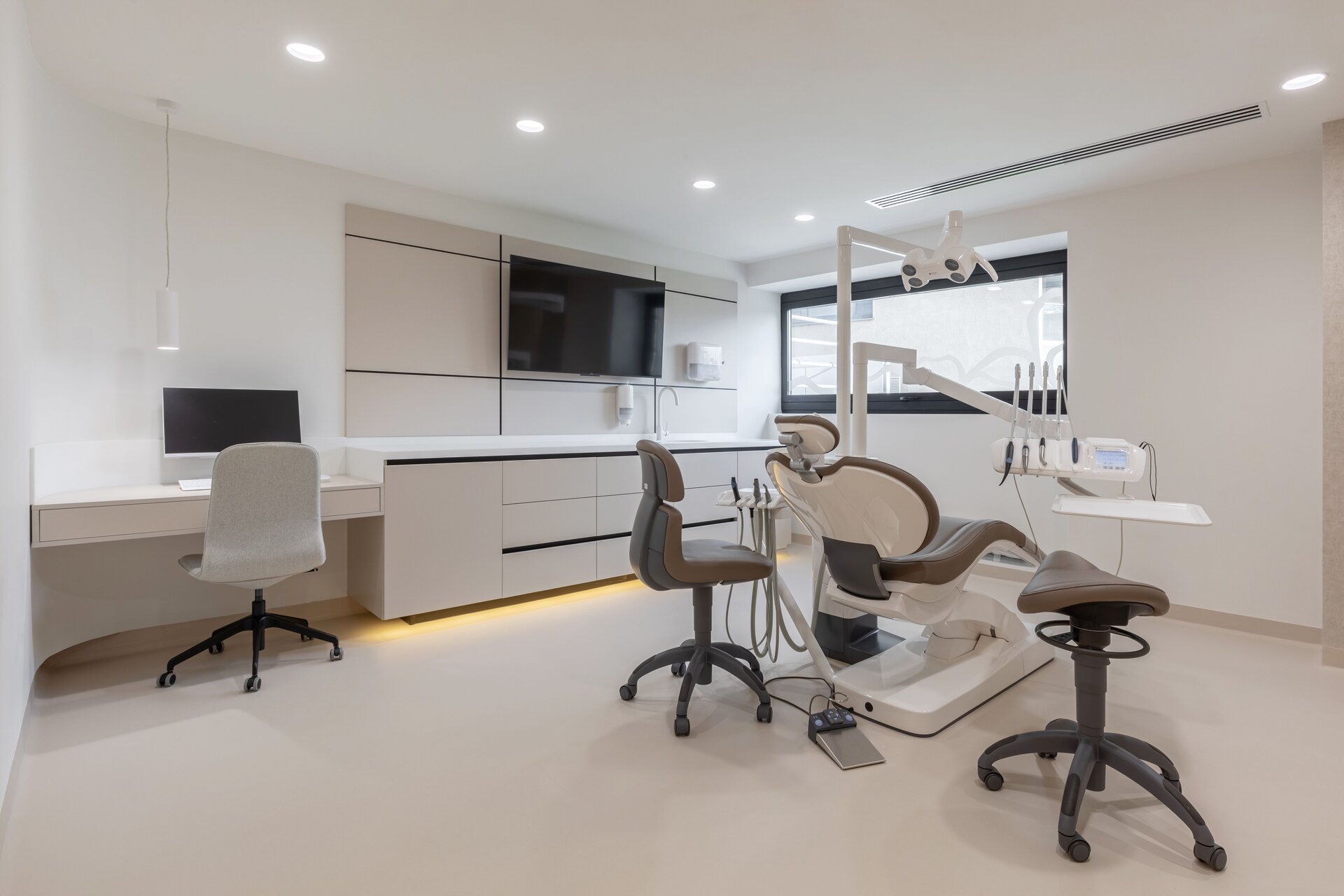
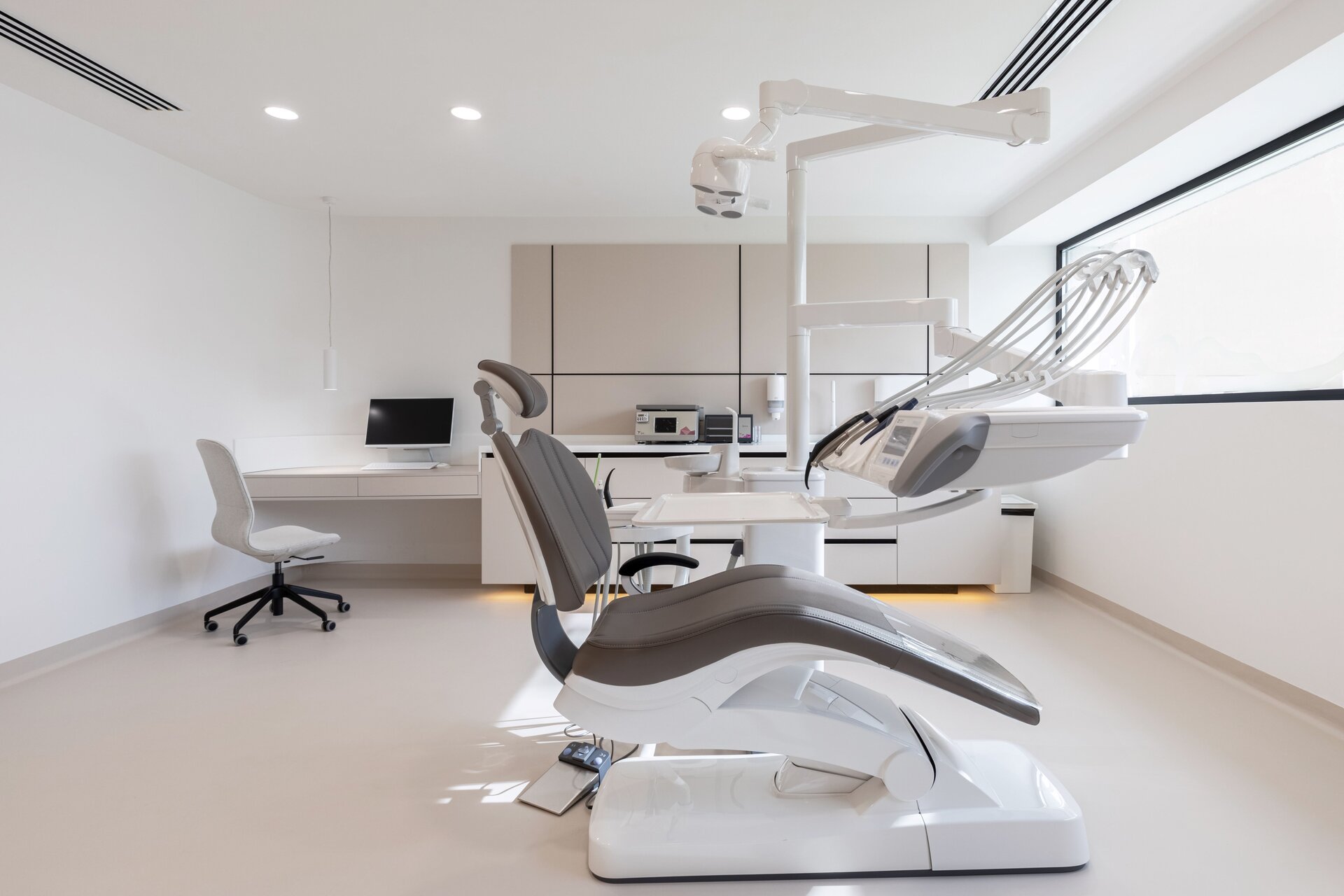
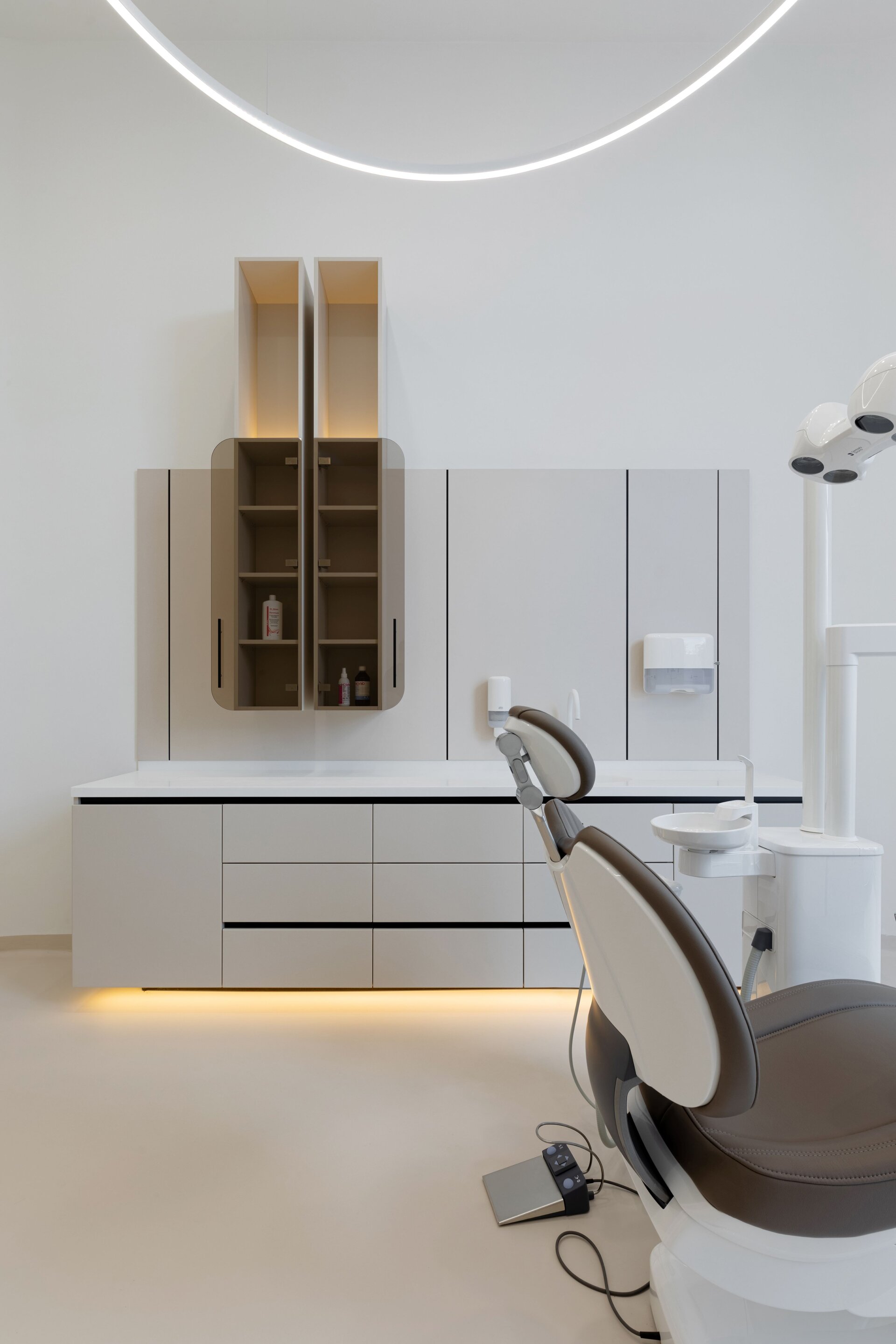
Complemented by the wide undulations of the personalized furniture, the serial folding theme on the walls, continues with narrow undulations in the cabinets, where natural light and a view to the outside intertwine with artificial LED light ceiling fixtures in lines or spotlights. Beige ribbed surfaces, integrated into the furniture bodies or arranged as panelling in the areas adjacent to the worktops, with a protective role in places of body contact, generate the vertical surfaces smallest reliefs and additionally contribute to the interior tactile experience.
This public space is thus constituted as an organic whole, dominated by surfaces with predominantly light tones (shades of white-grey) in dialogue with slightly darker tones (sand-grey on the floors, furniture and surfaces covered with decorative wallpaper). An attenuated contrast between these two major tones is also visually supported by the spatial nesting effect in an “L” configuration of the surfaces (horizontal plane and vertical plane with the same tone), along with their continuity in the depth of the distribution space towards the dentist’s offices. The colour of the floor is also present on the wall with wallpaper and integrated sofa for the waiting area, and the white tone on the ceiling returns to the opposite wall. In counterbalance, the sand-grey upholstery of the curved sofa in front of the reception overlaps the white wall with decorative pleats, and the white reception desk penetrates the darker surface of the floor.
Designed specifically for this space, the unique furniture design is essential for integrating vertical and horizontal surfaces into the composition and ensuring a unified atmosphere. It adds another layer of dynamic surfaces, with wider undulations, to generate seating areas and facilitate interaction between patients. Of note is the spatial role of the sofas, the reception desk made of composite material, shaped by vertical and horizontal curves, made of composite material, the suspended shelves made of beige MDF with decorative glass panels and the storage units with drawers and handle grooves with a minimalist plastic effect in keeping with the calm ambiance of the dentist’s offices.
The artistic installation suspended above the entrance area, a composition of curved facets in varying shades of white, like those of dental enamel, created by artist Ileana Oancea, makes a metaphorical reference to the facets used in dental aesthetics, but also to the delicate “suspended” installations of the American sculptor Alexander Calder. In the high space of the entrance area and in the directed light of the ceiling spotlights, this artistic intervention projects its reflections and delicate shadows on the undulating surfaces of the walls, generating a soothing atmosphere with dreamlike accents.
A calm and variable atmosphere that envelops the path to the dentist’s offices, activated by the vertical undulations of the walls and the ceiling light fixtures, naturally continues inside the treatment rooms, transforming the interior design into a tactile and vibrant experience. Attention paid to the balance between the tones of grey-sand, white and beige, use of embossed and smooth textures, dosage of artificial light and diversity of surface articulation lead this project towards an appreciation of the details in a cinematic sequence, so that the reading of the space finally recovers a coherent image of the whole, its well-cohesive formal identity and the welcoming atmosphere that envelops the patients from the very first moment of the interior experience.
Interior Design

- Atelier Amzei 13
- Terrarium 707
- Symbiosis
- Tins and Tonic - Gin Bar
- House in Amber Forest
- Wabi-Sabi Penthouse
- Japandi Apartment
- Beauty Clinique
- House Sf. Gheorghe Delta
- The Other Otter
- Cram
- DentOne Oral Rehabilitation Centre
- Narcissus
- Apartament 3L
- CP Interior design
- Apartment B.S.
- House S interior design
- Color Motion


