Forma: Operative fragment for the regeneration of urban memory
Authors’ Comment
Rewriting Memory into an Active Architectural Palimpsest
At the threshold between abandonment and potential, in the Vilkpėdė district of Vilnius, a former industrial railway complex—once a deposit of materials, a passageway for concrete, a mute reservoir of productivity—becomes the site of an architectural transformation. _FORMA does not seek to merely rehabilitate or repurpose. It proposes a complete rearticulation: a spatial structure in which memory is reactivated, matter is decoded, and urban marginality becomes cultural presence.
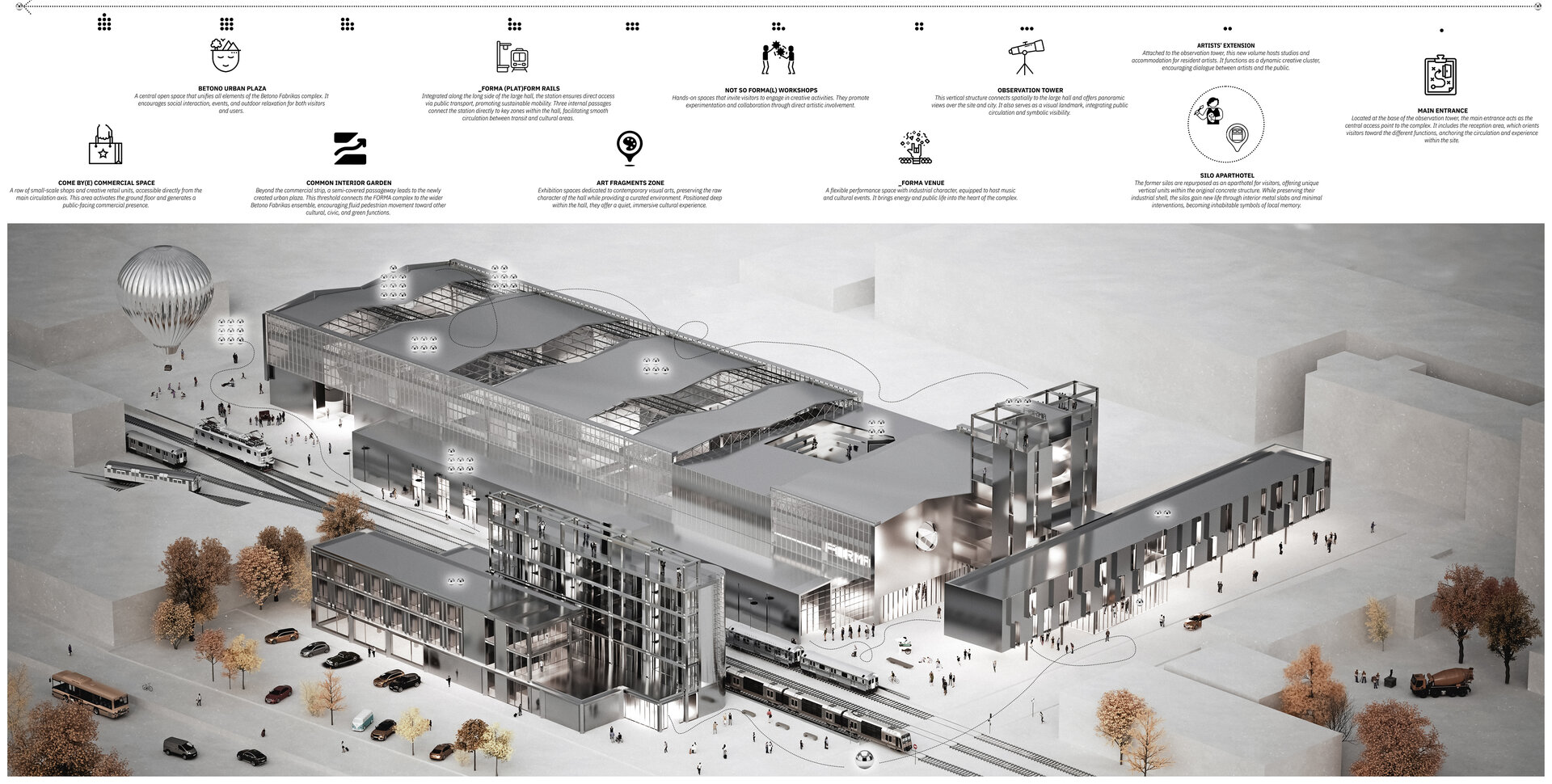
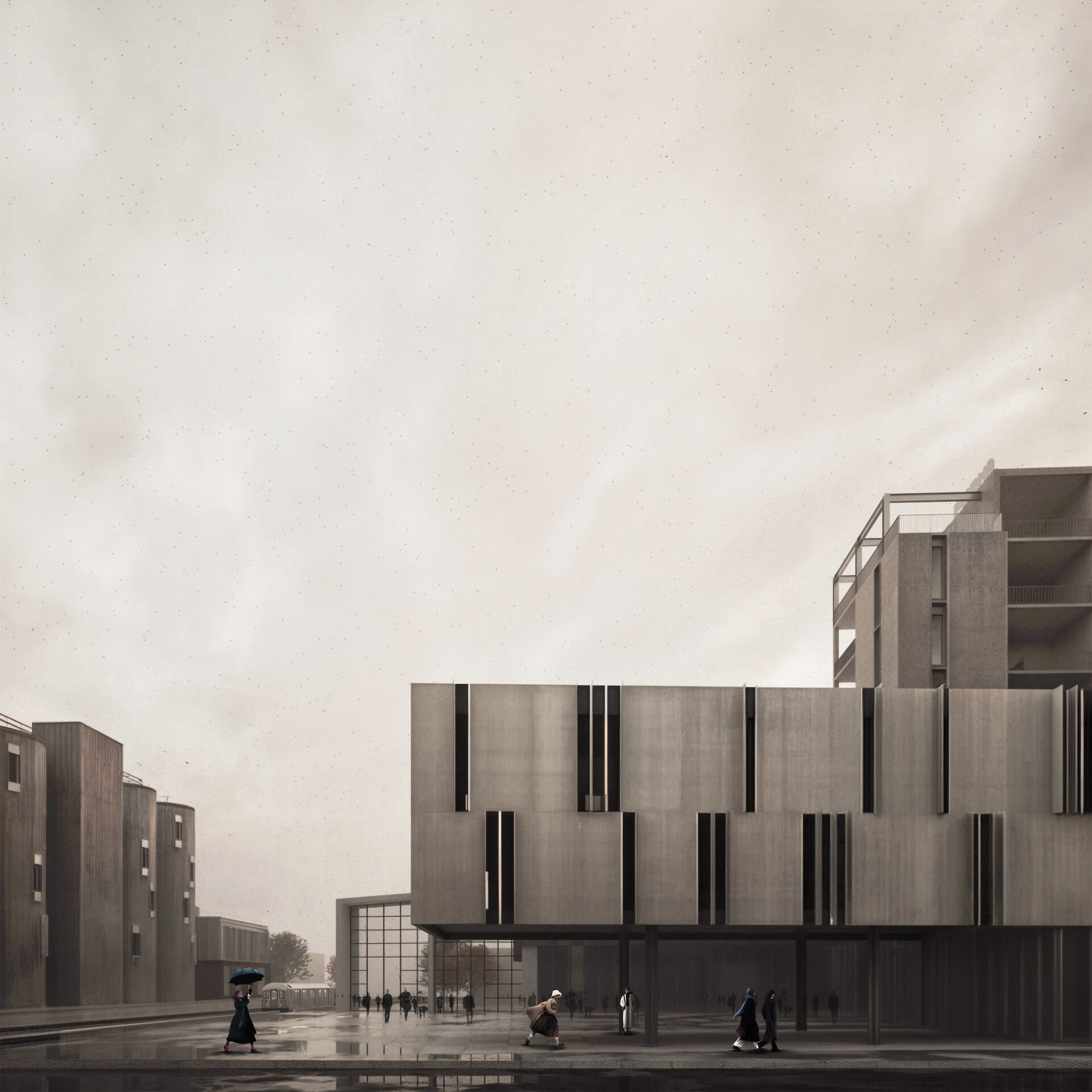
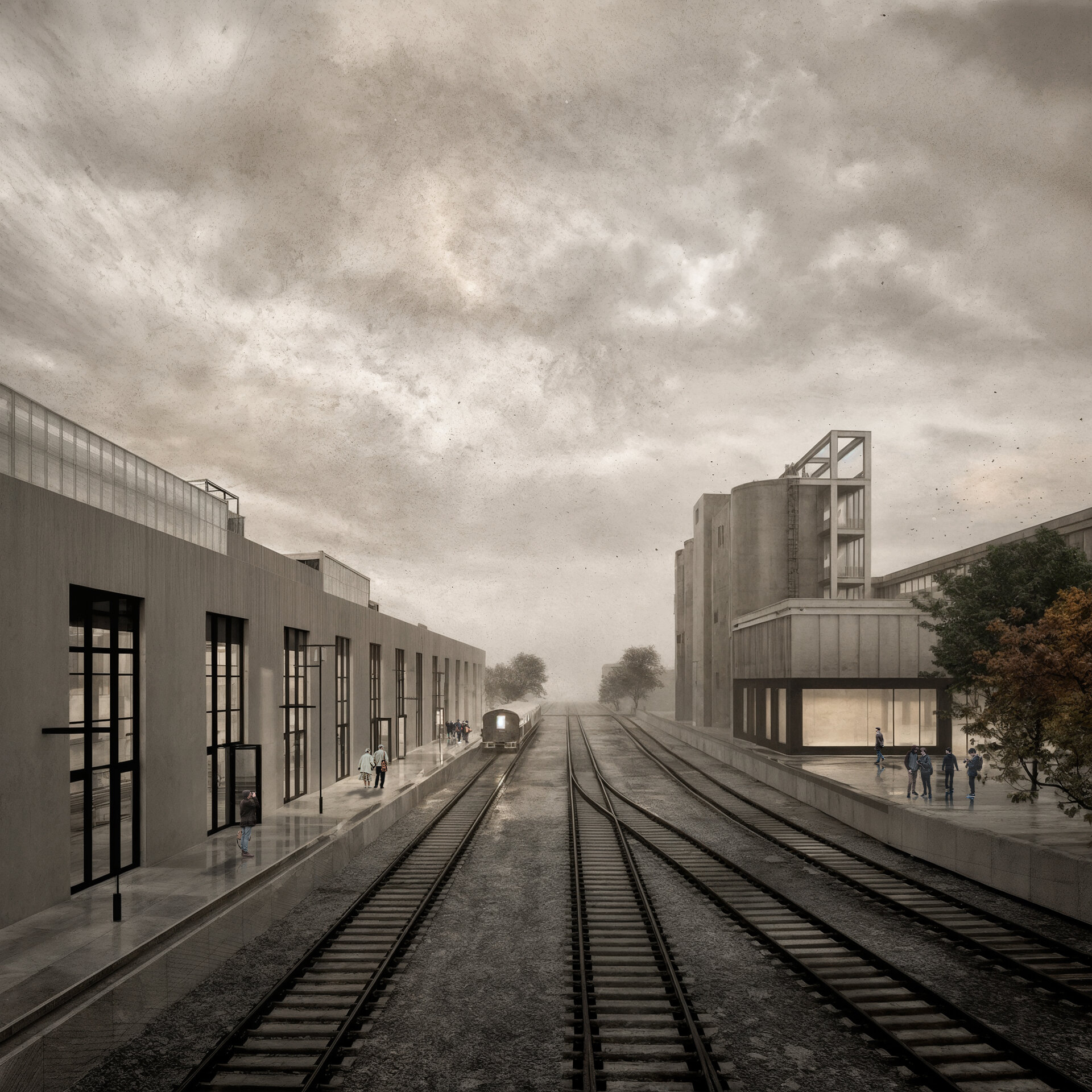
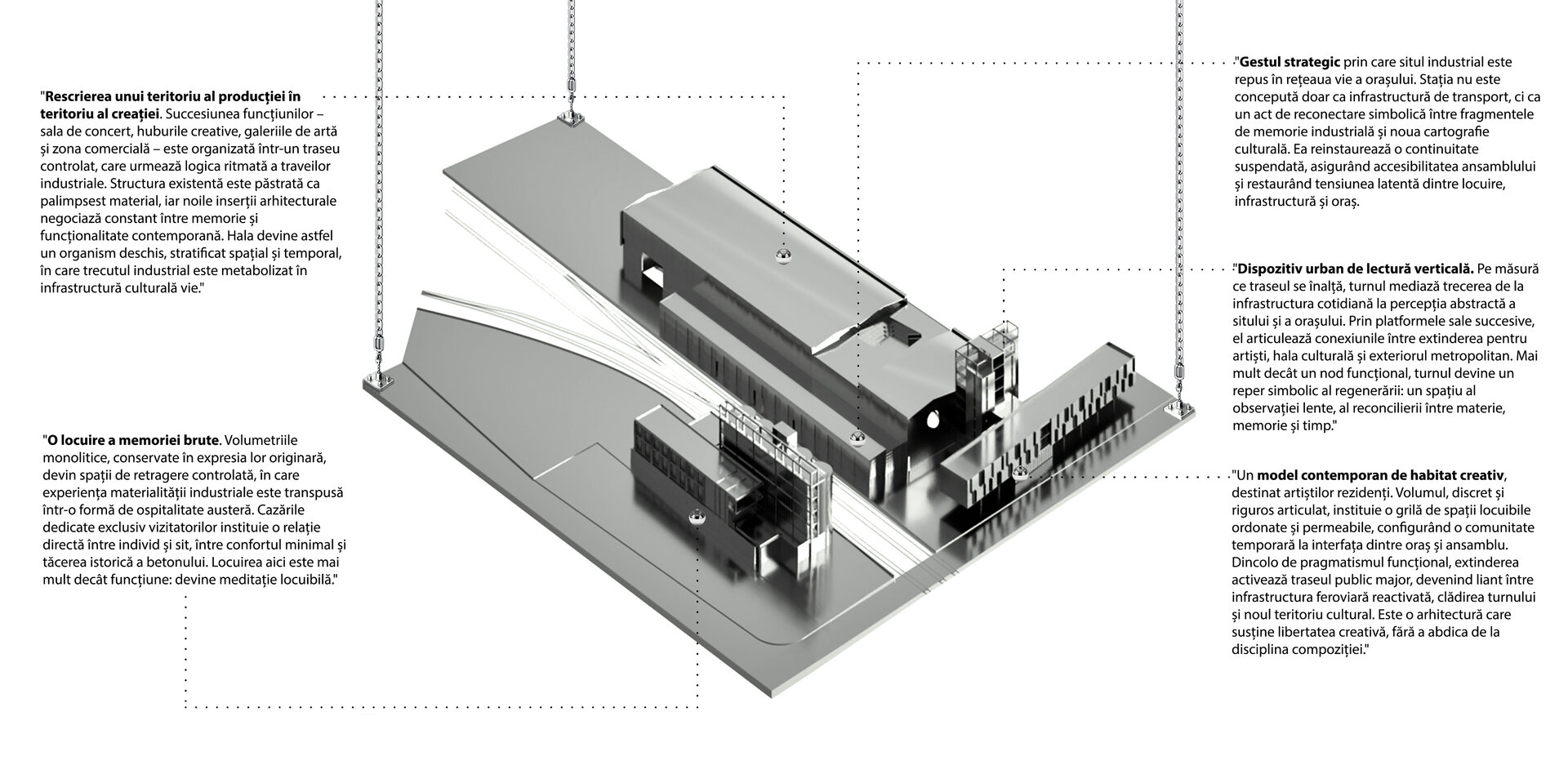
The original condition of the site revealed a disjunction of industrial fragments—an expansive main hall, a secondary structure seamlessly attached, a solitary observation tower, and a cluster of silos—surrounded by the latent infrastructure of obsolete rail lines. Rather than imposing a unifying intervention, the project chooses to emphasize the site’s fragmentary composition, transforming difference into compositional strategy. _FORMA constructs a coherent yet polyphonic ensemble, a sequence of architectural figures with formal autonomy and shared ideological coherence.
The conceptual approach rests on three operative axes: preserving material trace as evidence of collective memory, inserting new volumes with minimal physical impact on existing structures, and repositioning the site within the city’s cultural network, reimagining it as an emergent pole of attraction. Architecture here is not a gesture of detachment but a mechanism of reinsertion—through reading, revealing, and reinhabiting. The intervention is not about restoration but about constructing presence through controlled exposure.
The project refuses nostalgia and does not sanitize the past. Instead, it engages it critically, transforming industrial remains into spatial agents that perform new roles. The resulting ensemble does not seek unity through homogenization, but coherence through contrast, resonance, and spatial dialogue.
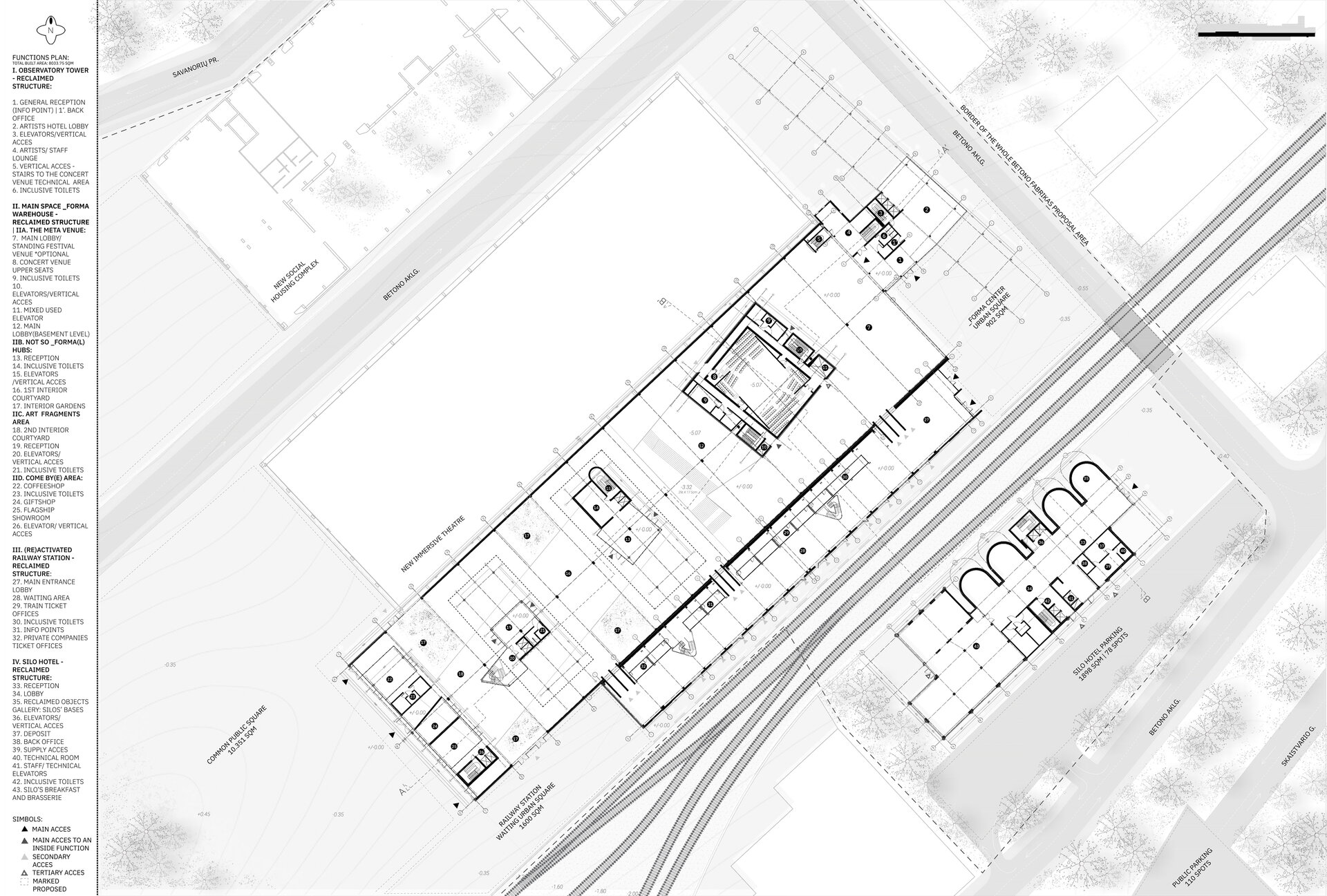
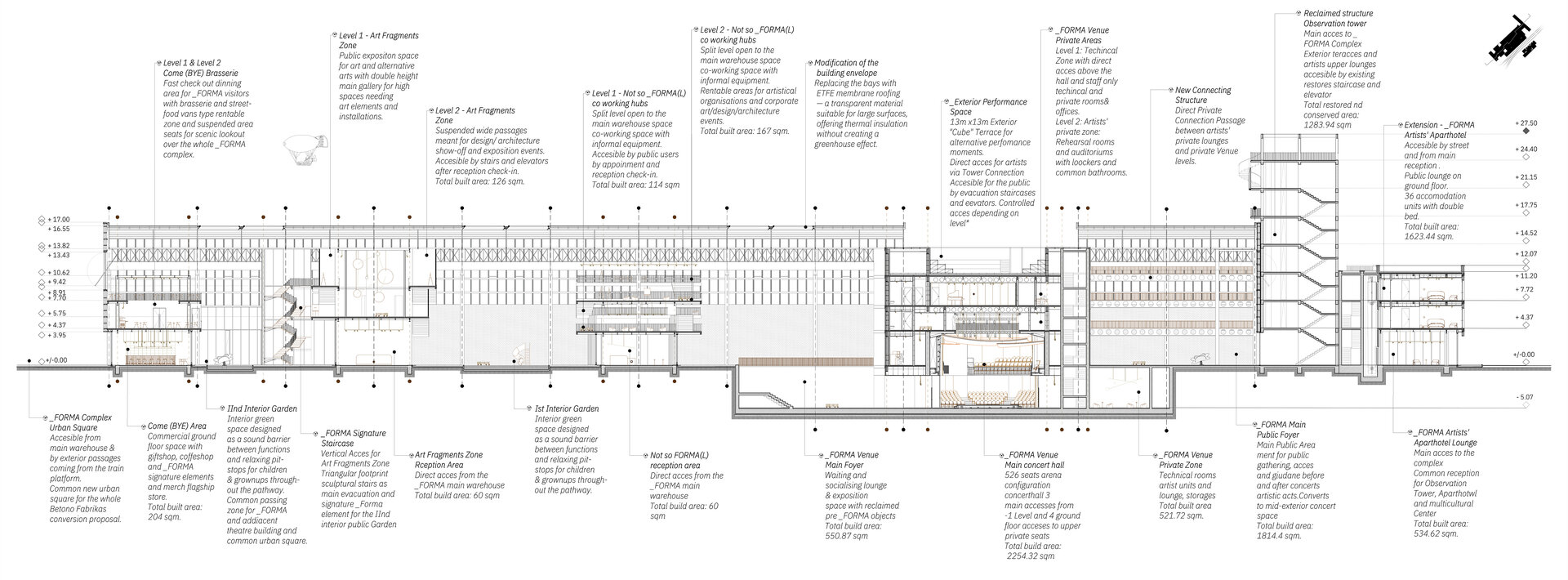
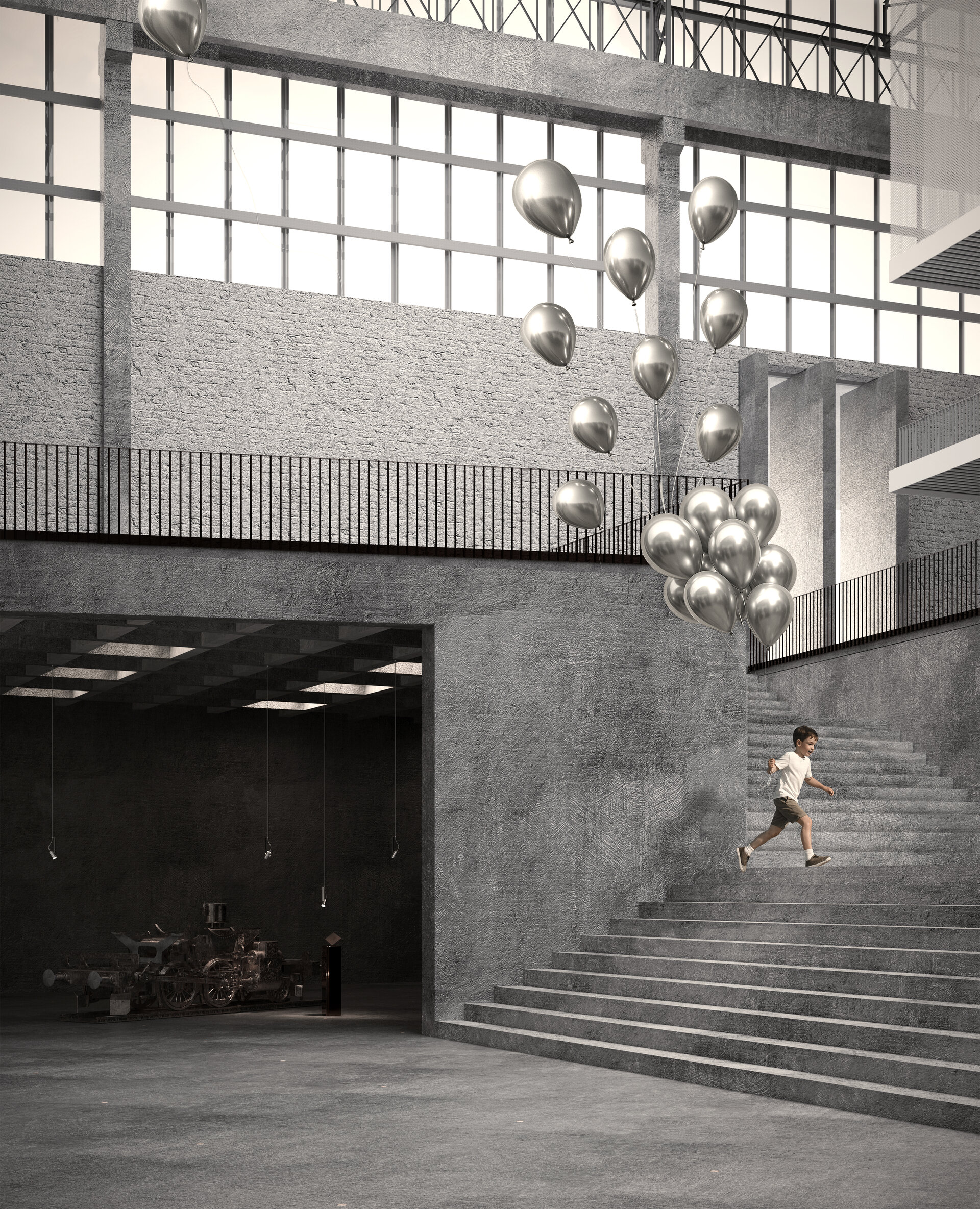
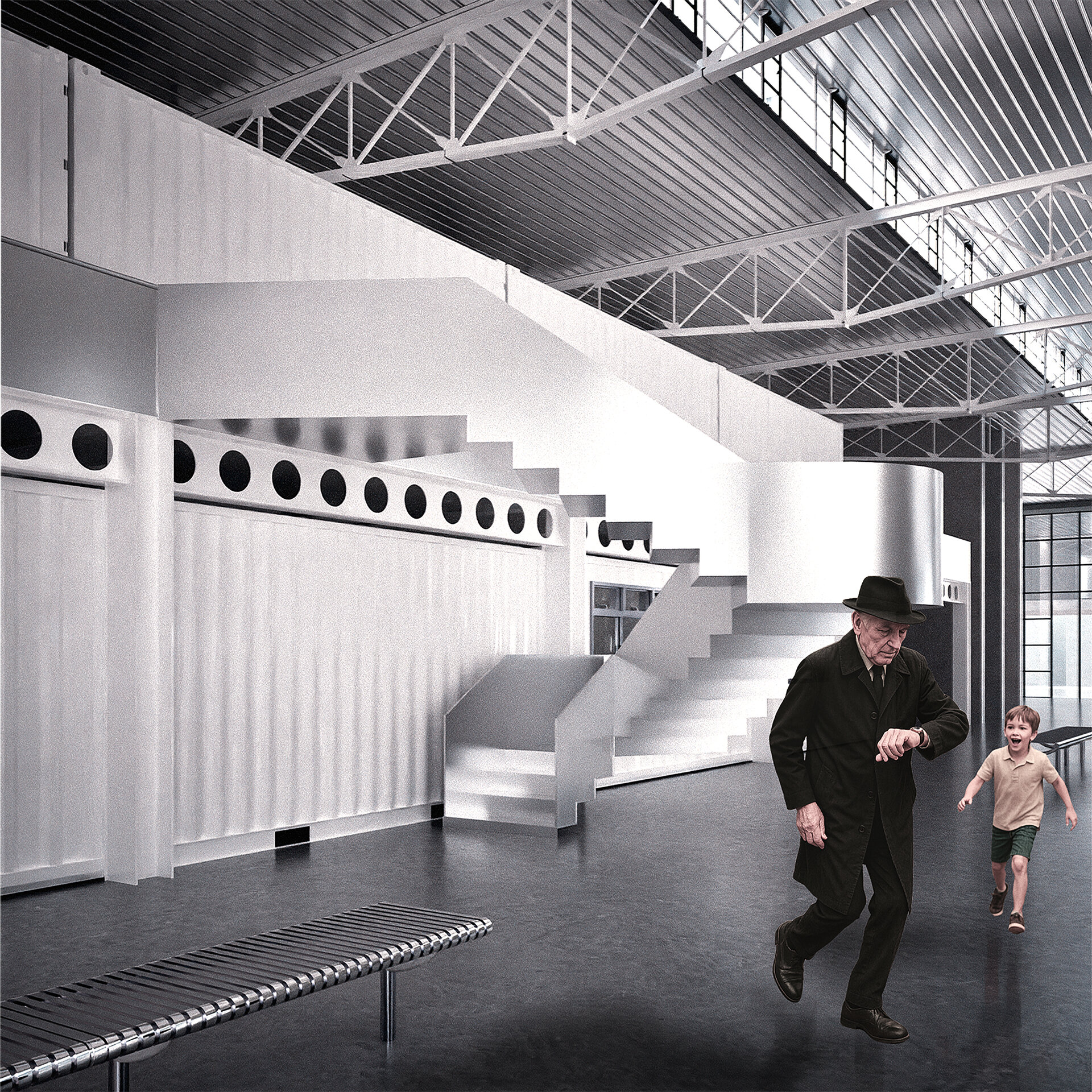
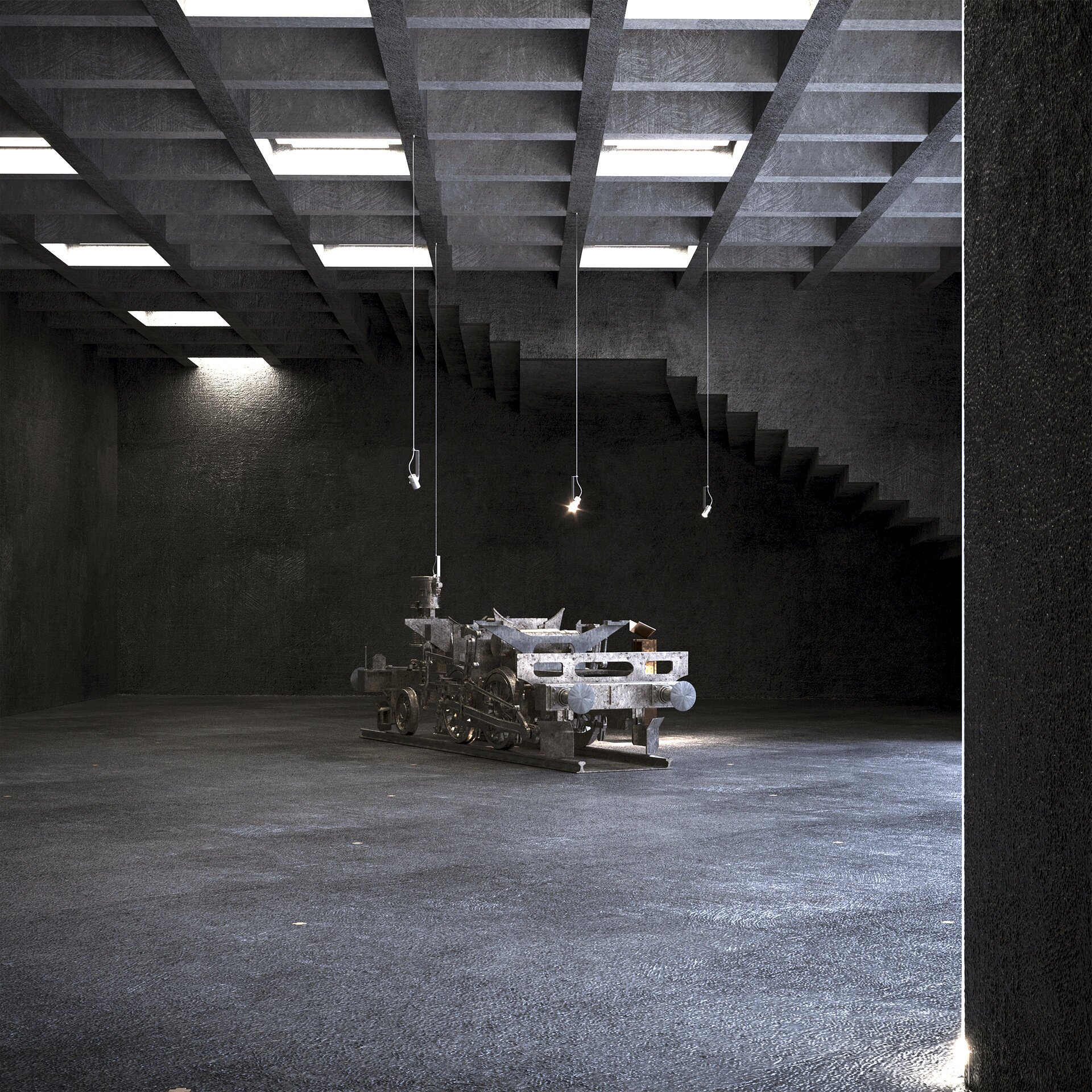
The main hall becomes the epicenter of the complex—an architectural condenser of four distinct but interconnected programs: a concert hall, a cluster of participatory workshops, an art gallery axis, and a commercial interface. These functions unfold along the original longitudinal axis of the hall, following the rhythm of the steel frames as compositional guides. The spatial syntax is not arbitrary; each intervention aligns with the structural rhythm, honoring the original tectonic logic while reconfiguring its spatial expression.
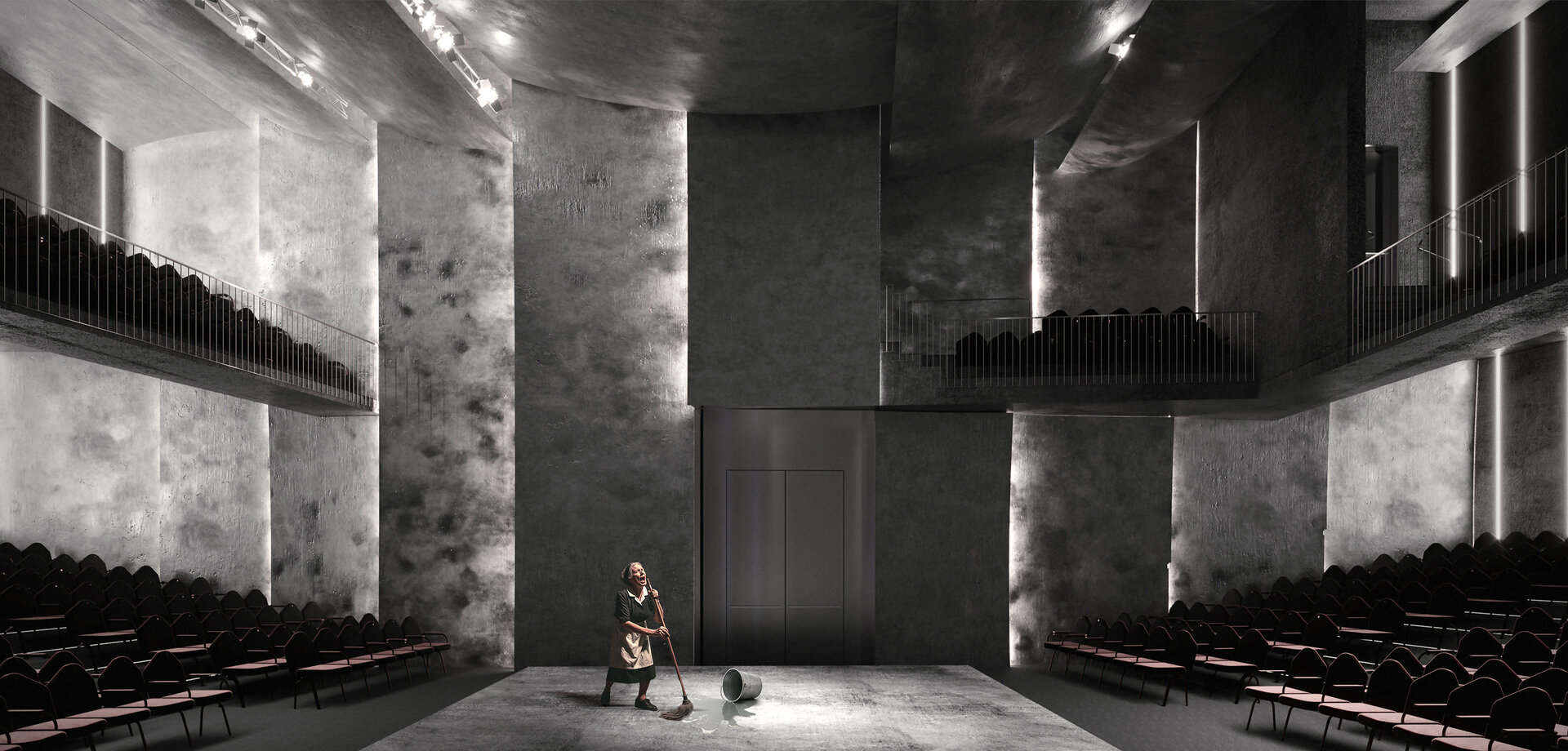
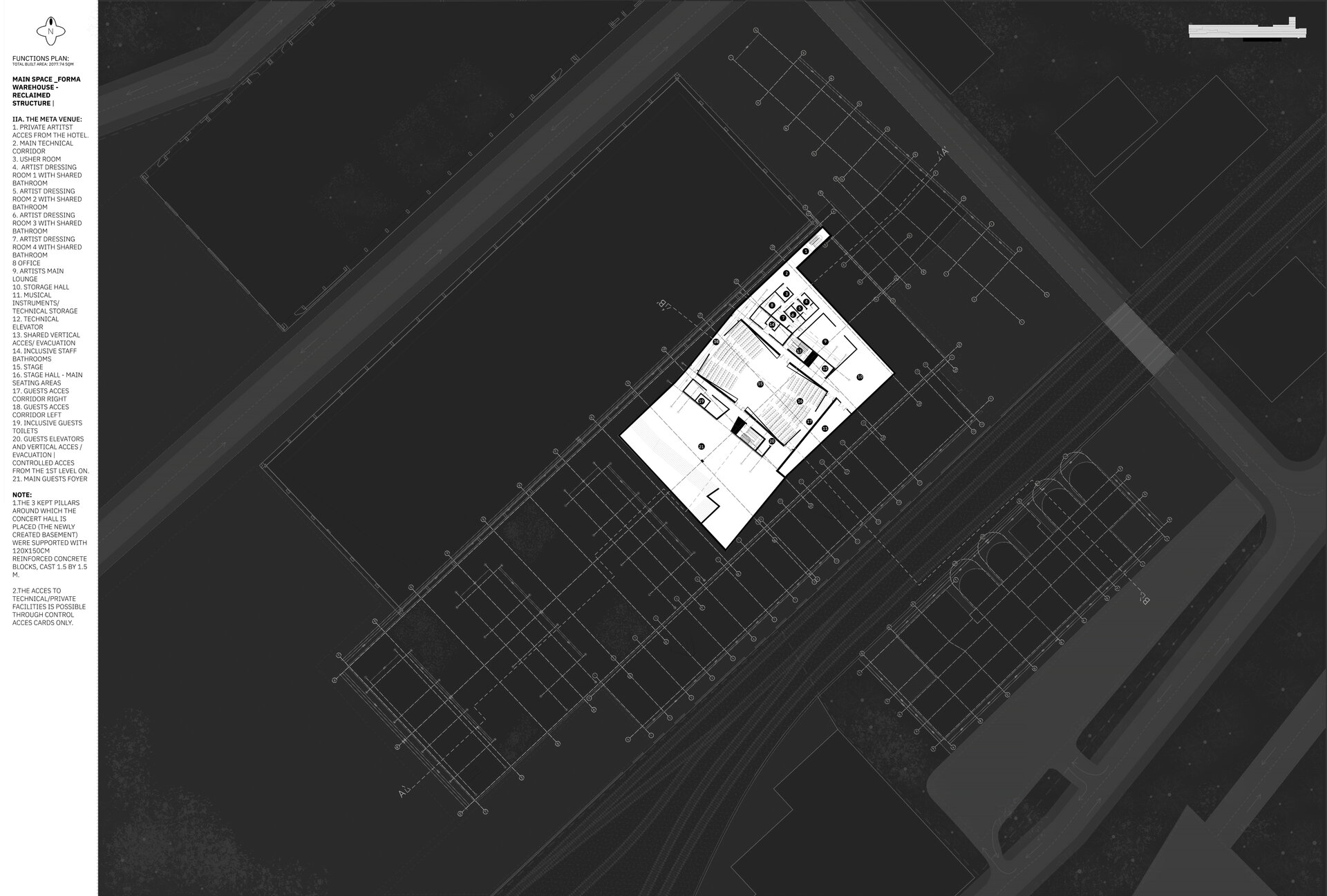
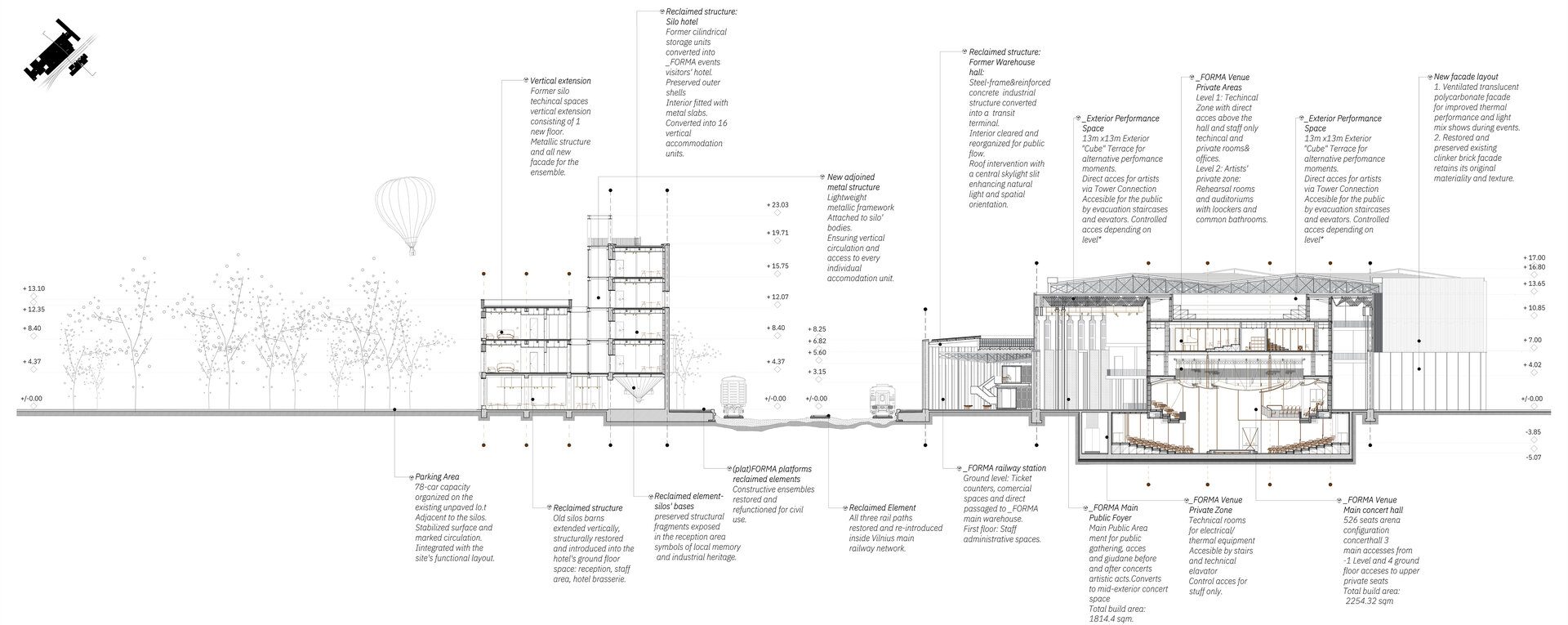
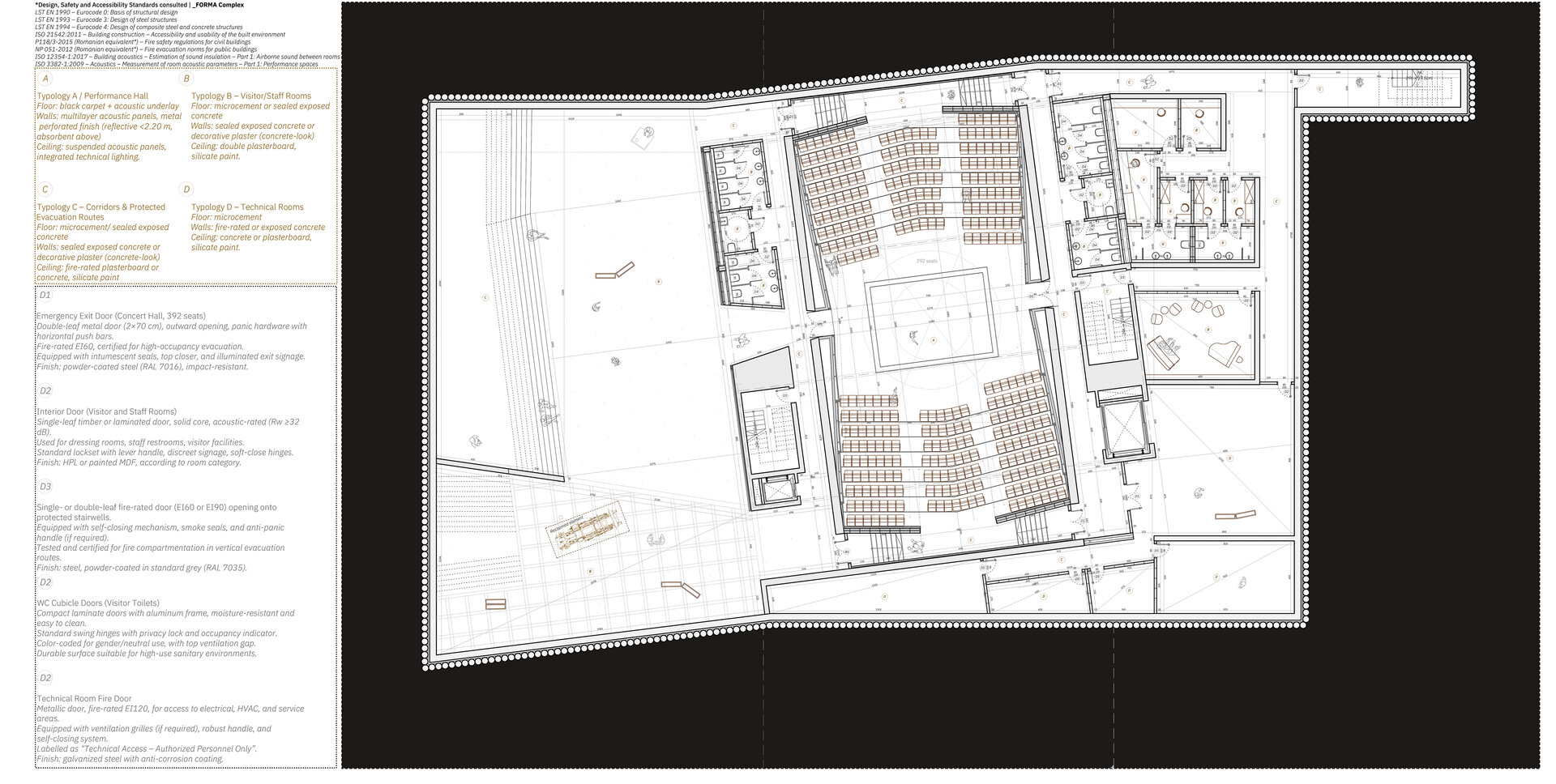
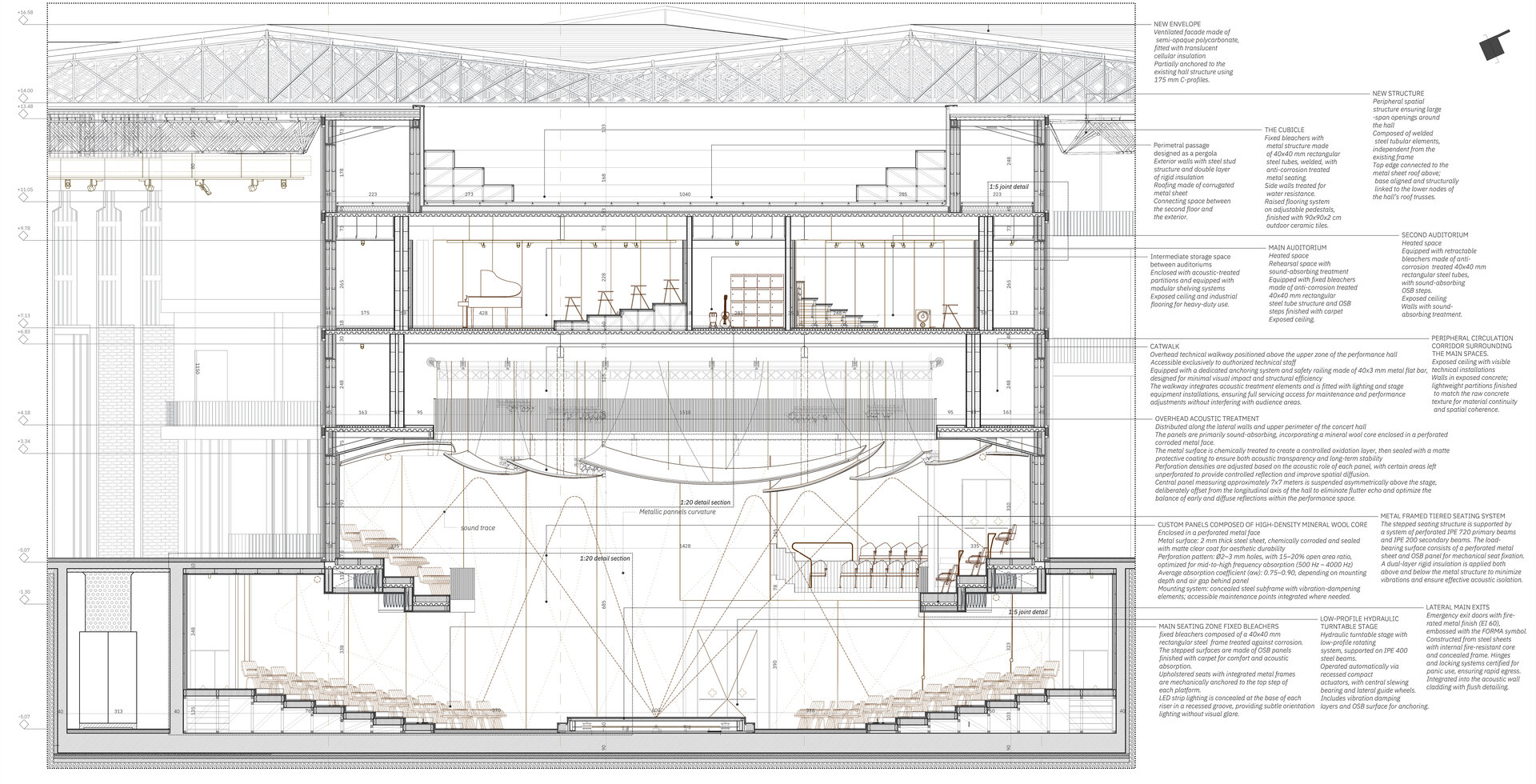
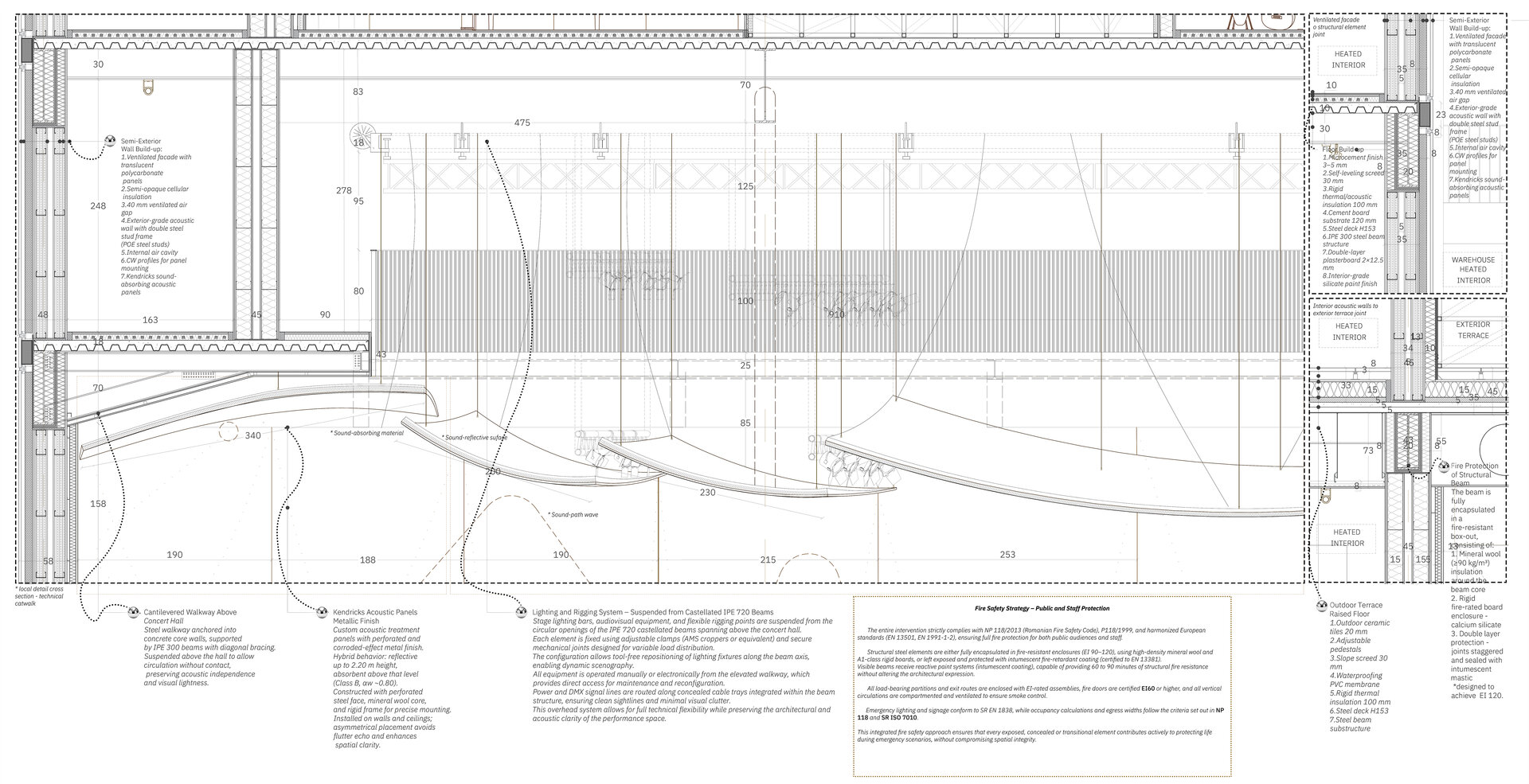
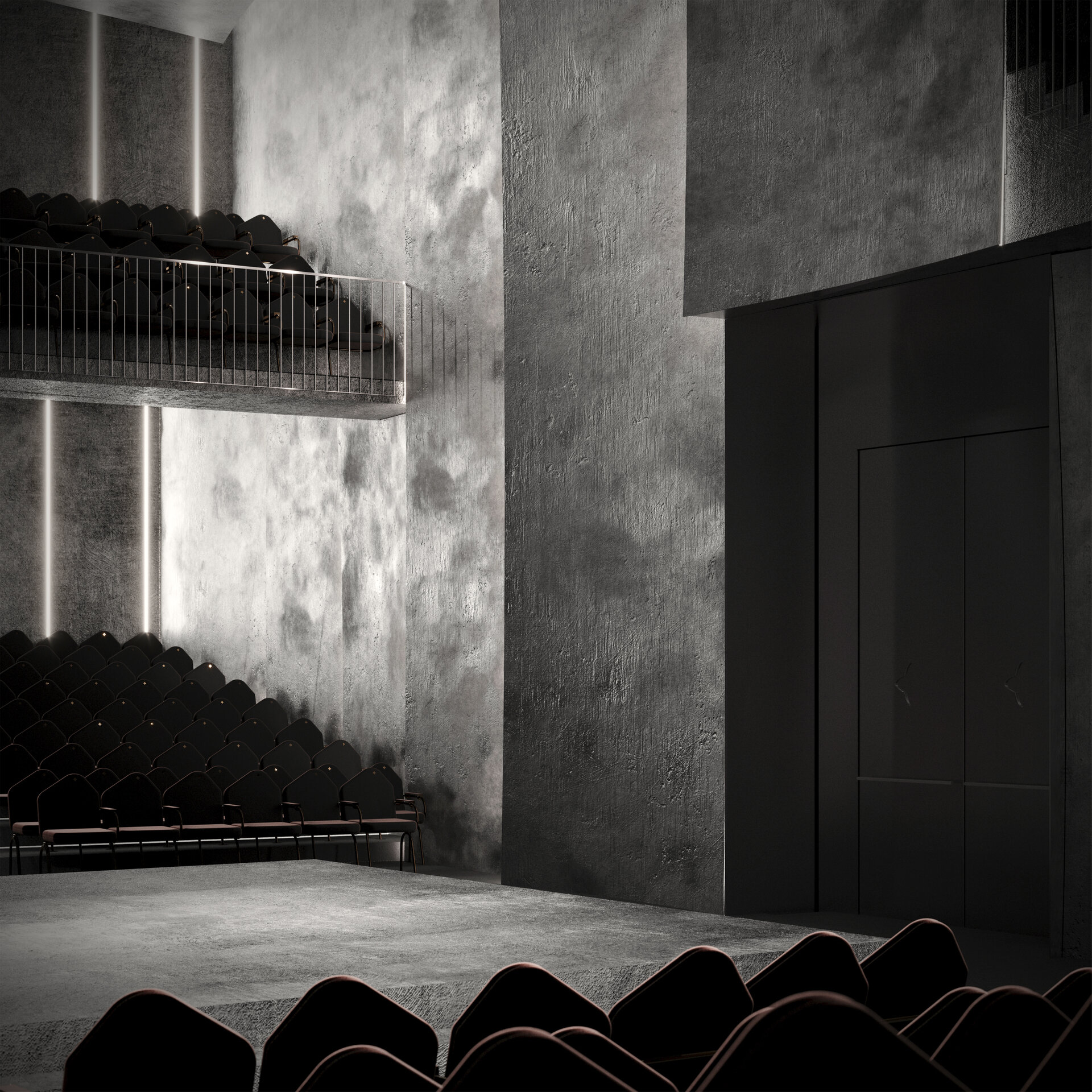
The concert hall is partially embedded below ground, responding both to the natural topography and the need to release vertical volume. The stage is placed centrally, allowing spectators to surround it on two levels, generating a spatial relationship of inclusion and acoustic intimacy. Sound treatments and stage mechanics are integrated within the structural framework, preserving the visual continuity of the space and amplifying its atmospheric quality. Above and around this core, the hall unfolds as an inhabited void, where suspended functions hover above a largely uninterrupted ground plane.
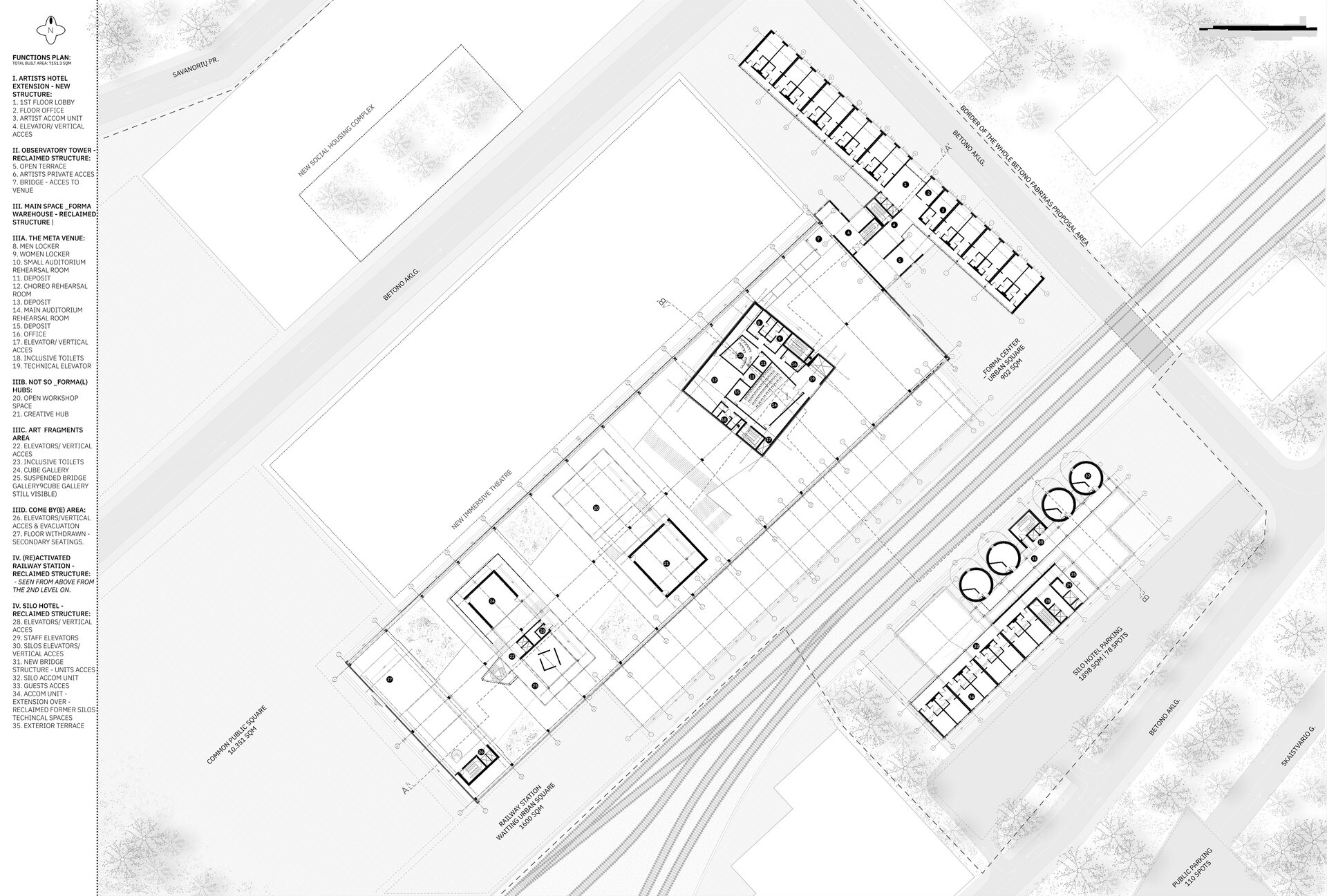
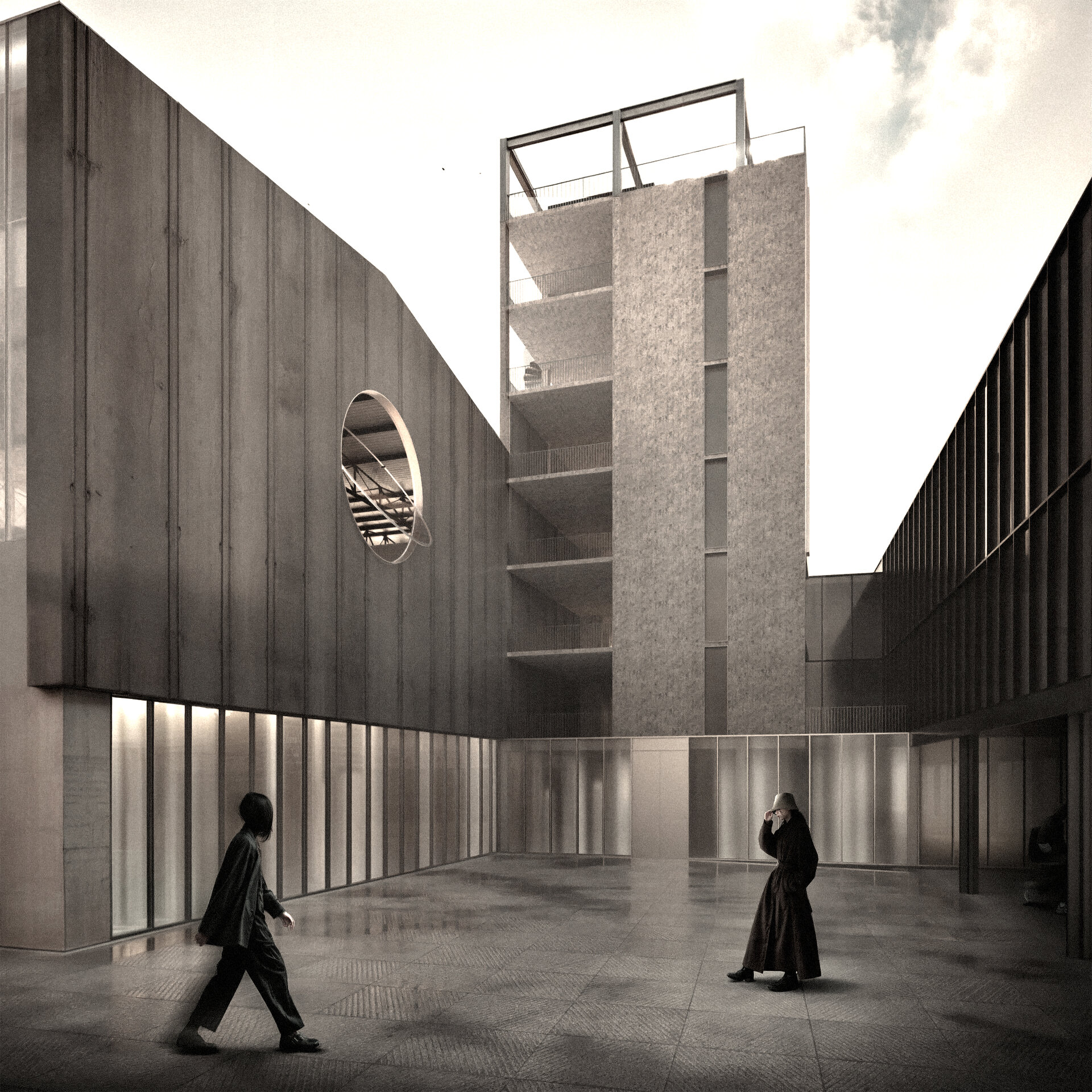
Workshops are housed within modular platforms, suspended or anchored to vertical cores, designed for flexible use—art production, public engagement, debate. They open toward newly introduced courtyards and green interstices, enhancing permeability and visual transparency. The art galleries operate as spatial thresholds—rooms for transition and pause, with large glazed surfaces and reconfigurable partitions. The commercial sector, composed of a café, gift shop, and mezzanine restaurant, concludes the visitor’s trajectory with a space of pause, encounter, and reflection.
The attached tower becomes a vertical device for observation and orientation. Through its transformation, each level offers a distinct spatial experience: reading rooms, belvederes, and introspective cells. It functions not only as a point of access but as an architectural punctuation—marking the moment of entry into the complex while symbolically rising above its industrial past. It is the first spatial act encountered by visitors arriving via the reactivated railway line—a passage not merely of transit but of anticipation.
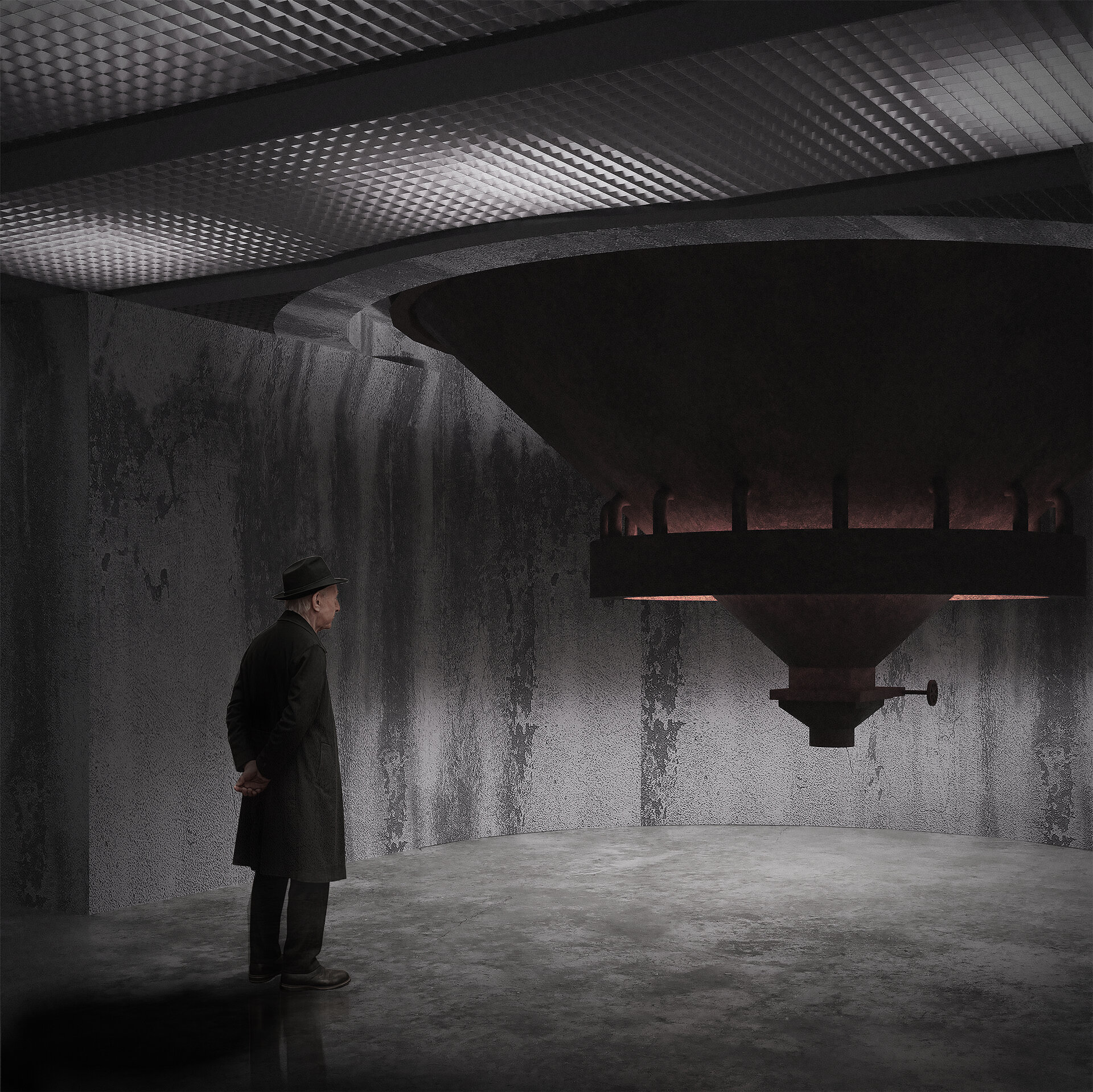
The silos are converted into accommodation units for visitors. Their transformation is surgical: inserting technical infrastructure while preserving the raw material character, perforated skins, and exposed concrete textures. These volumes do not attempt to mimic domesticity but rather propose a new kind of inhabitation—compact, vertical, and memory-laden. Each unit becomes an introspective cell, marked by time and reframed by inhabitation.
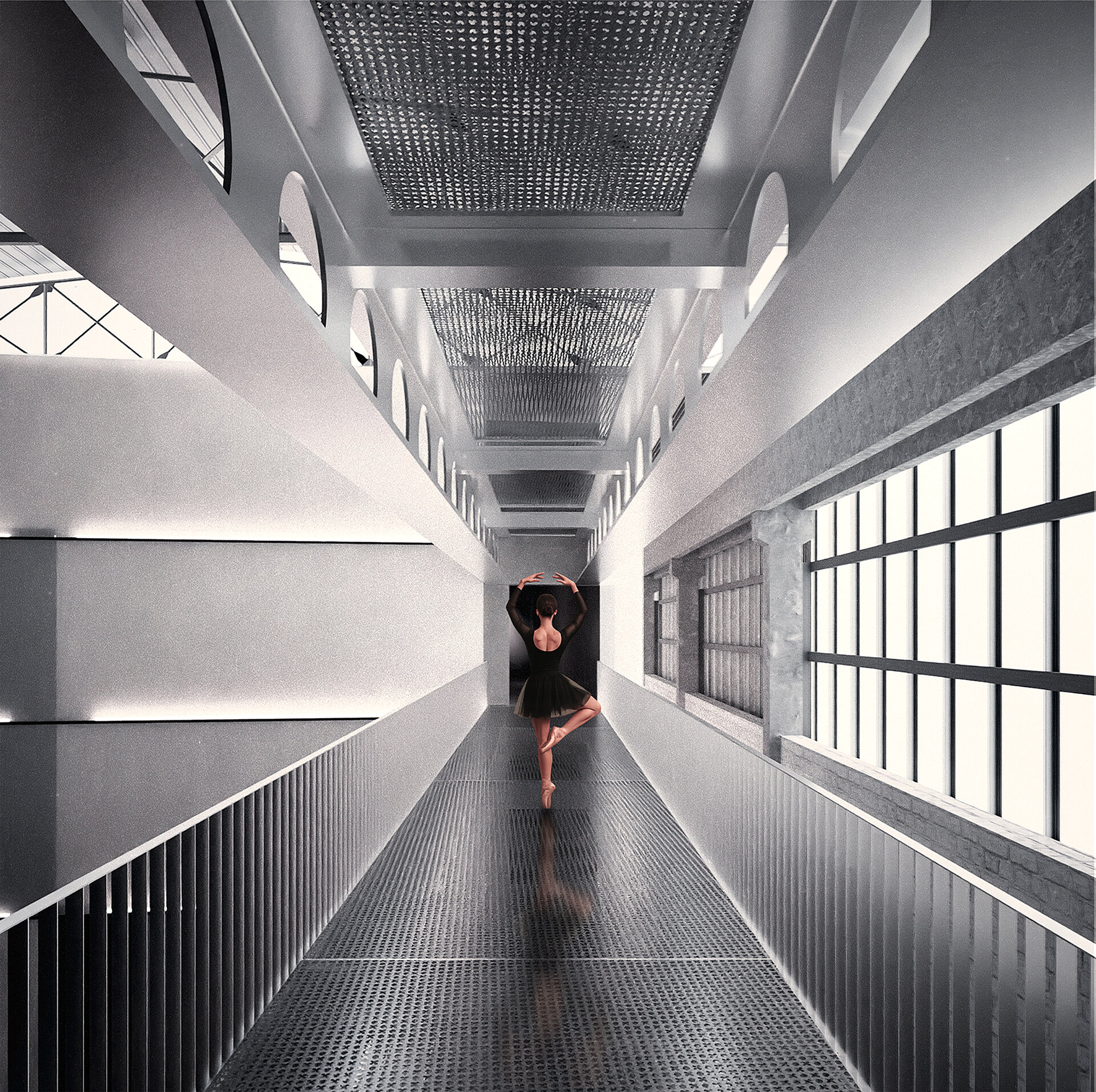
The contemporary extension, placed in front of the main hall, is dedicated to the artists-in-residence. The volume is low, recessed into the site, and fragmented into modular housing units that rest upon a green slab integrated into the public trajectory. Access is ensured through elevated walkways connecting the tower to the extension, forming a horizontal weave of movement without territorial rupture. The new volume does not compete with the existing masses—it operates in the background, providing support, continuity, and infrastructural coherence.
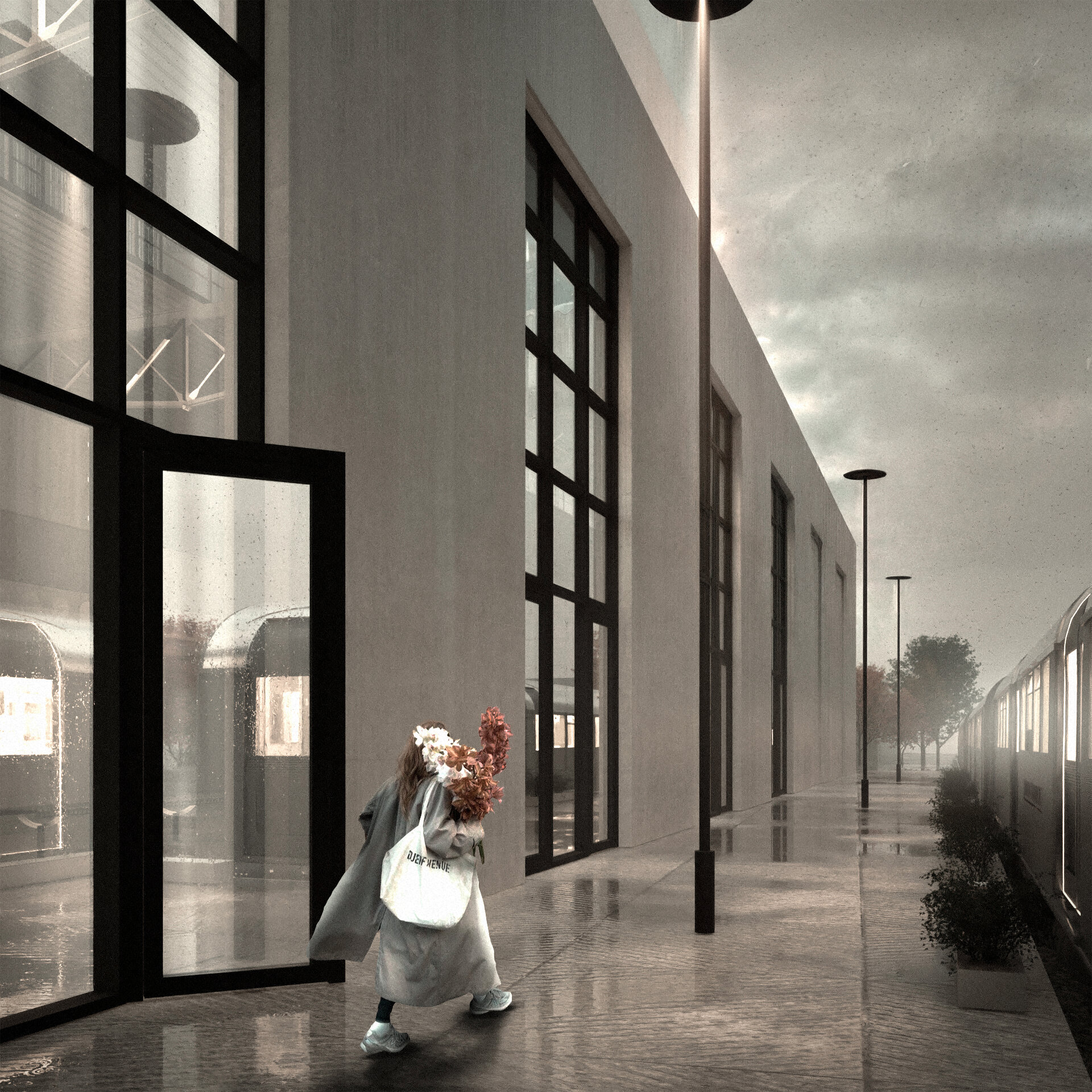
The small hall, seamlessly joined to the main structure, is converted into a railway station, reactivating a dormant mobility corridor. More than a logistical intervention, this gesture restores symbolic and physical connectivity between the site and the urban core. It offers a sustainable mode of access, redefining arrival as an architectural experience. The station is not a neutral threshold, but an introductory spatial act—a vestibule to the transformed complex.
All programmatic components operate in a spatial choreography governed by continuity, permeability, and rhythm. The palette is deliberately restrained—exposed concrete, oxidized metal, structural glazing—favoring tectonic expression over decorative surface. Architecture speaks through structure, proportion, and juxtaposition. The new does not mask the old; it frames it, traverses it, and enables its renewed presence.
User experience is not dictated, but orchestrated through a sequence of spatial encounters: descending into the concert hall, rising through the tower, traversing courtyards, entering light-filled galleries, inhabiting silos. Architecture becomes a narrative device, offering not a fixed story but a field of possibilities. Boundaries between programs are porous, transitions are gradual, and movement is layered. Circulations are made visible: ramps, staircases, catwalks, and voids act as instruments of orientation and perception.
The spatial grammar avoids symmetry. Instead, it adopts calibrated asymmetry derived from the interplay between existing structures and new insertions. No gesture is gratuitous: every line, volume, and incision responds to site, memory, and function. The architectural language is solemn, never monumental—assertive, but grounded in respect for the found conditions. Light is treated as material; sound is considered in composition; and time is inscribed through material permanence and traces.
The design refuses to idealize ruin or fetishize the industrial. It proposes an active form of memory, grounded in architectural legibility and open to reinterpretation. The ensemble does not fix the past in place but enables it to function in the present. In this way, _FORMA becomes an operative field—a site of cultural production, civic gathering, and spatial dialogue.
Circulatory logic is informed by transparency and overlap. No function is sealed: all volumes remain visually or physically permeable. Public and private realms negotiate their interface through elevation, offset, and filtering—never through exclusion. The green roof of the extension becomes an accessible platform; the gallery façade opens toward the workshop yard; the concert foyer overlooks the insertion courtyard. Every boundary is a place of encounter.
At the urban scale, the intervention is catalytic. It converts a residual industrial void into an active node within the metropolitan fabric. The project does not claim autonomy; it situates itself within flows—of people, ideas, mobility—and enhances them. The reactivated station becomes a tool of redistribution. The tower becomes a landmark. The hall becomes a container of civic presence. The silos become symbolic anchors. Each architectural gesture participates in reterritorializing the site.
More than a project, _FORMA is a proposition—a way of operating, of reading the city through its discontinuities. It reflects a position: that architecture can transform abandonment into presence, production into creation, ruin into resource. It demonstrates that adaptive reuse is not a compromise but a form of authorship: where the existing is not erased, but rewritten with precision, care, and architectural intelligence.
Architecture Diplomas

- Reclaiming Bucharest’s architectural heritage. Student dwellings and cultural establishments along Calea Griviței
- Rusticitas Et Urbanitas. Conversion and Expansion of the Solacolu Inn: Cultural Center for Arts and Architecture
- ONEF Stadium: an active method of working with history
- Extension of the Bucharest School of Arts
- Tineretului Agora. Rehabilitation and extension of the former Kiseleff Strand
- Diocesano Museum: The Cloisters of Sant’Eustorgio
- Marina Dorćol Educational center and library. Residual spaces. Between the city and the Danube in the post-industrial era
- The |YELLOW| complex - orphanage | placement center
- Extending the cultural space of the city center of Pitești
- Post Partum RetreatCenter / Steveston Hwy 13571
- Designing Learning Spaces for Brăila’s Youth
- Social and Educational Centre for kids
- Grădina Luterană: Dwelling and Workspaces for Creative Industries
- Multifunctional Performing Arts Centre, Berzei 21
- The school as a community core in the Rahova neighbourhood
- Politehnica University of Bucharest extension - Education & Research Centre
- Architecture of Forgotten Memory
- Students’ Sports Palaestra
- Versvs Museum
- Restoration and extension of “King Carol I” rural hospital in Filipestii de Targ
- Studios for artists on Leonida Street
- Luka Cargo Port Hotel and Convention Center, Belgrade, Serbia
- Diocesan Museum Extension
- Museum of the Anti-Communist Revolution of December 1989
- Post-treatment rehabilitation center for assistance and integration of addicted people into the contemporary community in Bucharest
- Immersive Theater – Industrial Heritage Regeneration Through Experimental Cultural Interventions
- Floreasca Olympic Aquatics Center, Bucharest
- Revitalisation of the Radák-Brukenthal Ensemble. Multifuncitonal Cultural Center in Micăsasa, Sibiu
- Intermodal Node in Piața Presei Libere – Bucharest
- Reviving the Identity of Ovidiu Island: Spa and Wellness Complex
- Palimpsest - The third cloister
- Casandra – from the memory of the place to a promising future: an initiatory journey of transformation
- The Creative District and the Fashion House in Arnhem, the Netherlands
- Extension and regeneration of the historical and museal space in Turda
- Research Center for the Reclamin of Polluted Mining Sites Baia Mare
- Interface with Lake Morii: Collective Housing
- #2-4 The intersection between community and art
- Reconnecting the City to the Water. Ferry Terminal in Zimnicea
- Tourist Complex in Sulina
- Arts Center. Revitalization of the Prohaska Mill in Timișoara
- Vitrum & Charta - The cultural library as a mediation between transparency and memory
- Urban Nodes
- Conversion of the former Bragadiru brewery
- Intervention on the Frankfurt Opera
- Bucharest Architecture Center
- Urban Liminality and The Cultural Turn: Vesterport Between Transit and Event
- Revitalization of the Courtyard of Domnița Bălașa Church in Bucharest
- Cito Sanum. Medical recovery center on Calea Moșilor
- Archaeological Research Institute Constanța
- In defence of the fortified church - Community center in Țapu village
- Cultural-Educational Forum - Extention of the Argeș County Museum, Pitești
- Dialogue Between Generations – Vatra Luminoasă Intergenerational Center
- Educational Community Center for children
- Reclaiming the boundary, Văcărești Delta
- Rehabilitation and Extension: Polyvalent Cultural Center - Chisinau, Republic of Moldova
- The Archive of Collections. A blueprint for recovering Bucharest’s cultural heritage
- The Bastion of Artists. A community centre dedicated to arts and crafts, located in the historic distric of Brașov
- Cultural laboratory for heritage studies in the historic center of Brașov
- Domaine les Ormes. Rural revitalization through artisan workshops and agrotourism in Allan, Drôme Provençale, France
- Külliye in time: the Ottoman complex in Medgidia between recovery and reinvention
- GabroArt Han. Archives of Tradition. The restoration of Gabroveni Inn and the socio-cultural activation of the nearby bazaar
- Cultural Establishment. Reactivation of Pompiliu Eliade House through conversion and extension
- The Center of an Edge. Restructuring the Commercial Market and Relocating the Neighbourhood Library
- The city around the colony. Reconversion and extension of the post office and the colony
- House of Film. The Rediscovery of the Cinematic Ritual in the Intimacy of Dwelling
- Game development center and interactive technology museum
- Conversion and Extension of the Radák-Brukenthal Noble Ensemble in Micasasa, Sibiu County. Socio-Medical Residential Center for Elderly People
- Forma: Operative fragment for the regeneration of urban memory
- Extension and Rehabilitation of Technical High Schools. Workshops for Vocational Education


